
A doctor treats a patient’s diabetes all year but never codes it on a single claim, and the practice’s whole risk score drops for that patient. Internal medicine billing runs on more than just visit codes — HCC coding shapes revenue in ways a lot of practices don’t fully track.
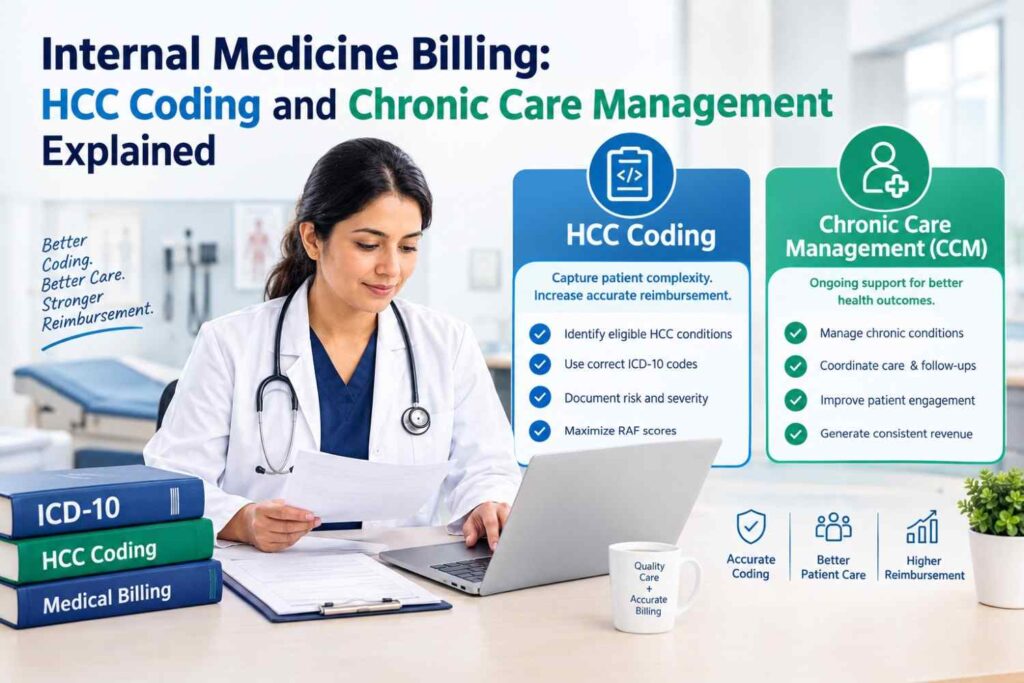
Internal medicine billing depends heavily on HCC (Hierarchical Condition Category) coding, which captures chronic conditions to set a patient’s risk score, plus chronic care management codes like 99490 for time spent managing those same conditions between visits. Missing an HCC code doesn’t just affect one claim — it lowers reimbursement for the whole year.
Why HCC Coding Affects A Whole Year
HCC coding assigns a risk score to each patient based on their documented chronic conditions. This score follows the patient year over year, not just within a single visit. Practices that skip this step often can’t see why their reimbursement dropped compared to last year.
1. How Risk Scores Actually Work
Every chronic condition coded during the year adds weight to a patient’s risk score. That score sets the expected cost of care, which then affects how much a practice gets paid under risk-adjusted plans.
2. The Once-A-Year Documentation Trap
A condition has to be coded at least once every calendar year to count, even if it hasn’t changed. Skip documenting stable diabetes at a visit, and that condition can drop out of the risk score entirely.
Chronic Care Management Ties Directly Into HCC
CCM billing pays for the ongoing work of managing conditions that HCC coding already tracks. The two systems work off the same list of chronic conditions, just for different purposes. One sets the risk score, and the other pays for the actual time spent on that patient’s care.
1. Why These Two Systems Overlap So Much
A patient with three HCC-coded conditions is often exactly the kind of patient who qualifies for CCM under code 99490. Coding the conditions accurately makes the CCM conversation with the patient easier to justify too.
2. The 20-Minute Threshold Still Applies
Code 99490 needs at least 20 minutes of non-face-to-face care coordination monthly. Fall short of that, and the month simply isn’t billable — no partial credit.
Documentation Habits That Protect Both Systems
Specific, current documentation supports HCC coding and CCM billing at the same time. Vague notes weaken both systems at once, not just one of them. A little extra detail in the chart pays off twice over.
1. MEAT Criteria For HCC Coding
A condition needs to be Monitored, Evaluated, Assessed, or Treated during the visit to count for HCC purposes. A condition listed in a problem list with no MEAT evidence gets flagged in audits (I’ve seen this wipe out risk scores retroactively).
2. Coding Specificity Over General Terms
Coding “diabetes” without complication detail misses the more specific codes that carry higher risk weight. Documenting the actual complication, like diabetic neuropathy, changes the risk score meaningfully.
Edge Cases That Cost Real Money
Recapture gaps and vague documentation quietly erode risk scores every single year. These issues rarely show up as an obvious denial. Instead, they show up months later as a lower payment nobody can quite explain.
1. The Annual Recapture Problem
A condition coded last year but skipped this year doesn’t carry over automatically. This ties into how annual wellness visit documentation works, worth a separate look on its own.
2. Multiple Chronic Conditions In One Visit
Coding five chronic conditions in one visit note without individual MEAT support for each one invites a downcode across the board, not just for the weakest condition.
Billrhealth’s Internal Medicine Billing Help
At Billrhealth.com, we manage internal medicine billing across HCC coding accuracy and chronic care management, checking MEAT criteria, catching recapture gaps before year-end, and tracking CCM minute logs; every engagement runs under clear terms and conditions, so your practice knows exactly what’s covered.
Key Takeaways
Internal medicine billing rewards documentation discipline more than raw coding speed. Pull a sample of patient charts and check whether every chronic condition coded last year still shows up with MEAT support this year. That single review usually reveals where risk scores are quietly slipping.
Another Important Source:
provider credentialing for Medicaid: All Explanation
FAQs – Internal Medicine Billing: HCC Coding and Chronic Care
Does A Chronic Condition Need To Be Coded Every Year?
Yes, HCC coding resets annually, so each condition needs fresh documentation to count again.
Can CCM Be Billed Without Meeting The 20-Minute Rule?
Nothing; code 99490 requires at least twenty minutes of non-face-to-face work that of the month.
What Happens If A Condition Lacks MEAT Support?
Auditors might remove that the condition’s risk weight more the entirely, lowering the practice’s projected reimbursement.
How do HCC coding and chronic care management differ?
HCC coding represents qualifying diagnoses for risk adjustment, while chronic care management focuses on ongoing care coordination and support for eligible patients with chronic conditions.
Why is accurate internal medicine coding important?
Accurate internal medicine coding supports complete clinical documentation, appropriate claim submission, compliant billing, and accurate reimbursement.