
Your internist spends 40 minutes untangling a patient with diabetes, hypertension, and early kidney disease. Then the claim bounces over one missing modifier. Sound familiar?
That’s exactly where internal medicine billing help earns its keep. Medical billing for internists means juggling multiple diagnoses, layered payer rules, and constant coding decisions. Small errors quietly drain revenue. We built Billr Health after years inside billing departments, clearinghouses, and payer organizations, so we’ll keep this practical: what support covers, where claims go wrong, and when outside help makes sense.
What Is Internal Medicine Billing Help?
Internal medicine billing help is professional support that turns your clinical work into clean, payable claims. Think of it as a translator between your chart notes and the payer’s rulebook.
Basic billing assistance submits claims. Specialized support understands why a 99214 with three chronic conditions needs different documentation than a one-off sick visit.

What Services Does Internal Medicine Billing Help Include?
Good internal medicine medical billing services typically cover:
- Patient registration and insurance verification
- CPT and ICD-10 coding
- Electronic claim submission
- Payment posting and reconciliation
- Denial management and appeals
- Accounts receivable (AR) follow-up
- Internal medicine revenue cycle management (RCM)
Why Do Internal Medicine Practices Need Specialized Billing Help?
Internal medicine isn’t routine office billing. One visit can involve diabetes, hypertension, and COPD, each needing documentation that supports your evaluation and management (E/M) level.
Then add preventive and annual wellness visits, Chronic Care Management (CCM), Transitional Care Management (TCM), and different Medicare and commercial requirements. Under-document a visit and you undercode it. Over-code it and you invite audits. Either way, reimbursement suffers. Our deeper dive on internal medicine billing, HCC coding, and chronic care management shows how.
Common Internal Medicine Billing Challenges and Their Solutions
Most internal medicine billing challenges trace back to a handful of causes. Here’s the problem-to-solution view:
| Problem | Why it happens | Solution |
|---|---|---|
| Claim denials | Wrong codes, missing data | Review before submission |
| Undercoding | Thin E/M documentation | Document complexity fully |
| Eligibility errors | Outdated coverage | Verify before visits |
| Modifier mistakes | Wrong modifier chosen | Run coding checks |
| Delayed payments | Slow follow-up | Track open claims |
| Medical necessity issues | Weak clinical notes | Match diagnoses to services |
How Can Practices Prevent Recurring Billing Errors?
Fix the cause, not just the claim:
- Audit claims regularly
- Train billing staff on internal medicine rules
- Keep patient records accurate
- Track payer-specific requirements
- Analyze denial patterns
Automated claim scrubbing catches many of these before a payer ever sees them.
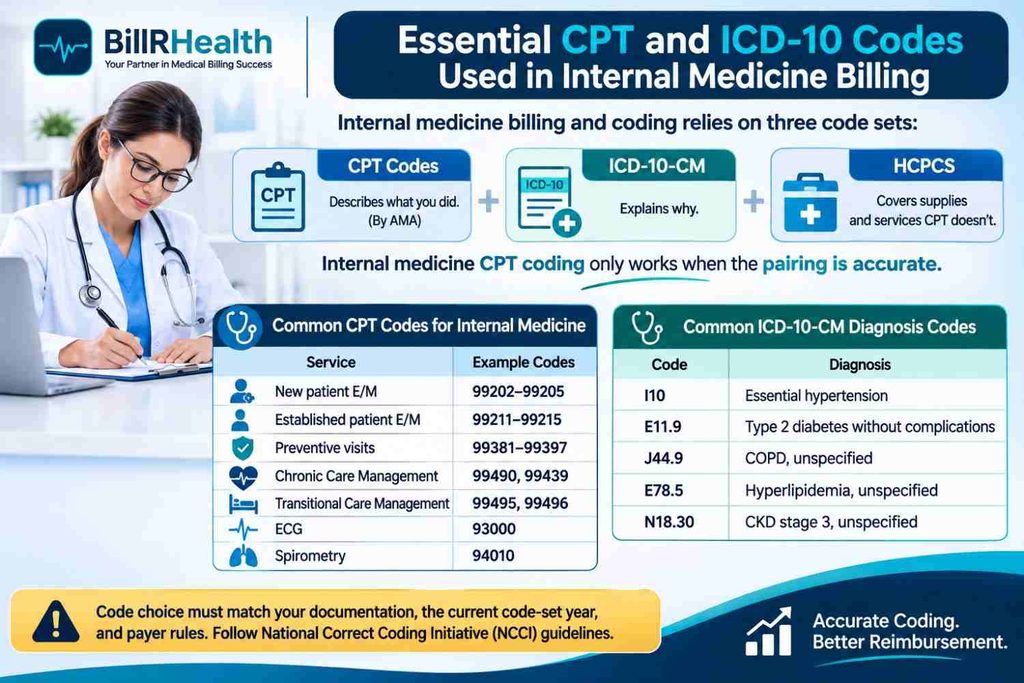
Essential CPT and ICD-10 Codes Used in Internal Medicine Billing
Internal medicine billing and coding relies on three code sets. CPT codes, maintained by the American Medical Association (AMA), describe what you did. ICD-10-CM explains why. HCPCS covers supplies and services CPT doesn’t. Internal medicine CPT coding only works when the pairing is accurate.
Common CPT Codes for Internal Medicine
| Service | Example codes |
|---|---|
| New patient E/M | 99202–99205 |
| Established patient E/M | 99211–99215 |
| Preventive visits | 99381–99397 |
| Chronic Care Management | 99490, 99439 |
| Transitional Care Management | 99495, 99496 |
| ECG | 93000 |
| Spirometry | 94010 |
Common ICD-10-CM Diagnosis Codes
| Code | Diagnosis |
|---|---|
| I10 | Essential hypertension |
| E11.9 | Type 2 diabetes without complications |
| J44.9 | COPD, unspecified |
| E78.5 | Hyperlipidemia, unspecified |
| N18.30 | CKD stage 3, unspecified |
Code choice must match your documentation, the current code-set year, and payer rules. National Correct Coding Initiative (NCCI) edits also flag bundling conflicts, supporting medical coding compliance. These are examples, not billing instructions. Always verify current code descriptors and CPT updates.
How Does the Internal Medicine Medical Billing Process Work?
Think of billing as a relay race. Each stage hands the baton to the next, and a fumble early on shows up as a denial weeks later.
Step-by-Step Internal Medicine Billing Workflow
- Patient registration and demographics
- Internal medicine insurance verification (eligibility checks)
- Clinical documentation and charge capture
- CPT and ICD-10 code assignment
- Claim scrubbing and electronic submission
- Payment posting and reconciliation
- Denial follow-up and appeals
- AR monitoring and reporting
How Can Professional Billing Help Reduce Claim Denials and Revenue Leakage?
Experienced billers check claims before submission, review modifiers, verify medical necessity, file on time, and chase underpayments. That’s the heart of internal medicine claim denial management, and it supports insurance reimbursement optimization.
Picture a four-provider practice where Aetna and UnitedHealthcare each want slightly different documentation for CCM. Without someone tracking those rules, claims stall. With specialists watching payer behavior, patterns get fixed once. Our denial management team does this daily.
What Do Real Healthcare Claim Denial Statistics Tell Us?
| Finding | Reported data | Source |
|---|---|---|
| In-network claims denied, ACA Marketplace insurers (2024) | 19% | KFF |
| Overall denial rate, Massachusetts insurers (2024) | 20.4% | Massachusetts Health Policy Commission |
| Denied professional medical/surgical claims tied to administrative reasons (Massachusetts) | 80% | Massachusetts Health Policy Commission |
These figures cover different populations. They aren’t the denial rate for internal medicine practices. But the lesson holds: most denials are administrative, which makes them preventable. Billr’s AI-assisted scrubbing delivers a 98% first-pass claim acceptance rate, versus an 85% industry average.
What Should You Look for When Choosing an Internal Medicine Billing Company?
Look for proven internal medicine experience, CPT, ICD-10-CM, and HCPCS expertise, Medicare and Medicaid knowledge, strong denial processes, HIPAA-compliant data handling, transparent reporting, certified coders, and solid EHR integration. Our practice owner’s checklist goes deeper.
Questions to Ask Before Hiring a Billing Company
- Do you have internal medicine billing experience?
- How do you track and resolve denied claims?
- Which performance reports will I receive?
- How do you protect patient information?
- What’s your pricing structure?
In-House vs. Outsourced Internal Medicine Billing: Which Is Better?
| Factor | In-house | Outsourced |
|---|---|---|
| Staff | Managed internally | Managed by provider |
| Technology | Your investment | Often included |
| Training | Your responsibility | Provider handles it |
| Scalability | Limited by headcount | Adapts to volume |
| Oversight | Direct control | Requires communication |
| Costs | Salaries, overhead | Contract-based fees |
The right choice depends on practice size, claim volume, budget, and in-house expertise. Billr’s pricing runs 3–5% of collections across three plans. See our guide to outsourced billing costs.
How to Measure the Performance of Your Internal Medicine Billing Process
Don’t stop at total collections. Track these revenue cycle KPIs and investigate any downward trend:
| KPI | What it measures |
|---|---|
| Clean claim rate | Claims accepted without initial errors |
| Denial rate | Share of claims denied |
| Days in AR | Average time payments stay outstanding |
| Net collection rate | Collectible revenue actually received |
| First-pass resolution rate | Claims resolved without rework |
Frequently Asked Questions About Internal Medicine Billing Help
What Does Internal Medicine Billing Help Include?
It includes CPT and ICD-10 coding, insurance verification, claim submission, payment posting, and denial management. Together, these services help internists get paid accurately and on time while reducing administrative workload.
Why Do Internal Medicine Claims Get Denied?
Common causes include coding errors, incomplete documentation, eligibility problems, missing prior authorizations, and weak medical necessity support. Most are administrative rather than clinical, so better front-end checks and pre-submission review can prevent them.
Is Outsourcing Internal Medicine Billing Worth It?
Often, yes. Outsourcing helps when your staff is overloaded, denials keep climbing, or you need specialized expertise without hiring more people. The billing partner supplies trained coders, claim-scrubbing technology, and consistent follow-up on unpaid claims.
What CPT Codes Are Commonly Used in Internal Medicine?
Frequent categories include E/M visits (99202–99215), preventive visits (99381–99397), CCM codes like 99490, TCM codes 99495 and 99496, and diagnostic services such as ECG 93000 and spirometry 94010. Always verify current code descriptors.
How Can Internal Medicine Practices Improve Their Reimbursement Process?
Document each visit thoroughly, verify eligibility before every appointment, submit clean claims, and follow up on denials consistently. Tracking payer patterns and KPIs like days in AR shows exactly where revenue is leaking.
Final Thoughts: Get Reliable Internal Medicine Billing Help to Improve Your Practice’s Revenue Cycle
Specialized billing support protects coding accuracy, prevents denials, and speeds up payment. Take a hard look at your current workflow: where do claims stall? If you’d like a second set of eyes, explore our internal medicine billing services or request a free billing assessment.
Important sources:
CMS: 2026 Medicare Physician Fee Schedule updates
CMS Chronic Care Management guidance
KFF 2024 Claims Denials Analysis
Massachusetts Health Policy Commission denial research

Billr Health was founded by healthcare revenue cycle veterans who spent years inside billing departments, clearinghouses, and payer organizations — and saw exactly where the revenue was being lost. We built the company we wished had existed when we were on the other side of this problem. Our founders spent years working inside billing departments, RCM companies, clearinghouses, and payer organizations. They saw the same problems across every practice they worked with — staff overwhelmed by claim volume, denials not being appealed, AR aging without anyone noticing, coding that was systematically leaving money behind.