
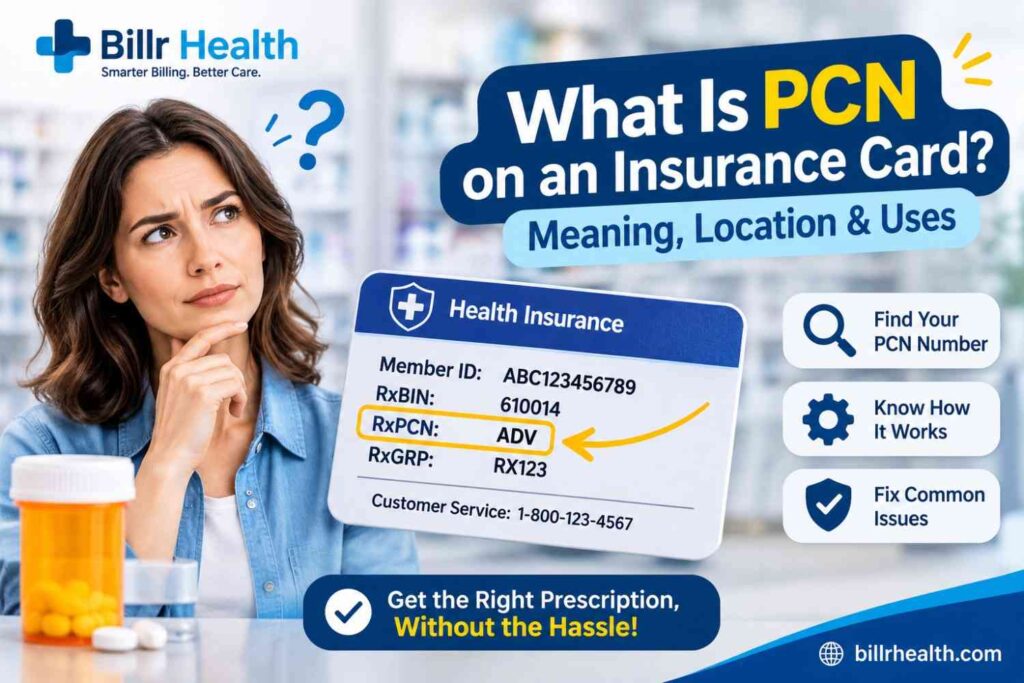
The PCN on an insurance card is your Processor Control Number, a secondary identifier that helps route prescription claims to the correct processor. Confusing? Picture standing at the pharmacy counter while the technician asks for it and you squint at a card full of numbers. This guide explains what PCN means, where to find it, and how to fix it when a claim rejects.
What Is PCN on an Insurance Card?
Short answer:
PCN stands for Processor Control Number, a code that helps pharmacies route your prescription claim to the right processor.
The National Council for Prescription Drug Programs (NCPDP) describes it as a secondary identifier that may be used in pharmacy transaction routing. Think of RxBIN as the street address and PCN as the apartment number. It usually appears alongside your RxBIN and RxGroup, but not every plan uses one.
What Does PCN Stand For?
Processor Control Number. It isn’t a personal ID, and it doesn’t identify you. Formats vary: letters, numbers, or both. PBMs, processors, and plans assign their own, so there’s no central PCN registry.
How Does a PCN Number Work in Pharmacy Claims Processing?
When you hand over your card, this happens in seconds:
- The pharmacist enters your RxBIN, PCN, group, and member ID.
- The pharmacy sends an electronic prescription claim.
- BIN and PCN, where applicable, route it to your pharmacy benefit manager (PBM).
- The processor runs pharmacy claims adjudication, checking coverage, copay, and drug rules.
- A response returns: paid or rejected.
Why Do BIN and PCN Work Together?
RxBIN points to the broad destination, PCN adds routing detail, and RxGroup identifies your benefit group. Miss one, and your claim can land in the wrong place.
Where Can You Find the PCN on Your Insurance Card?
- Front: look for RxPCN near RxBIN and RxGRP.
- Back: check the pharmacy benefits section.
- Digital card: open your insurer’s app or member portal.
Layouts vary by insurer and plan.
What Does a PCN on an Insurance Card Look Like?
| Card field | Example |
|---|---|
| RxBIN | 123456 |
| RxPCN | ABC123 |
| RxGRP | GROUP01 |
| Member ID | ABC987654 |
These are fictional examples, not real credentials.
PCN vs. BIN vs. Group Number vs. Member ID
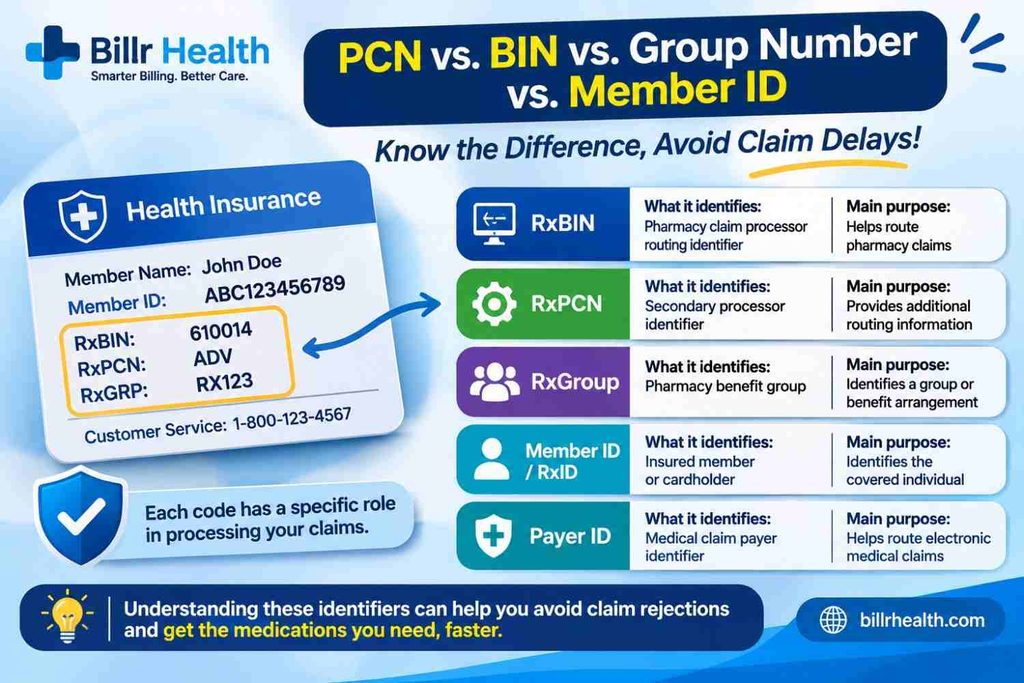
Billing teams see these mixed up all the time. Here’s your cheat sheet:
| Identifier | What it identifies | Main purpose |
|---|---|---|
| RxBIN | Pharmacy claim processor | Primary claim routing |
| RxPCN | Secondary processor identifier | Extra routing detail |
| RxGroup | Pharmacy benefit group | Identifies your benefit arrangement |
| Member ID / RxID | You, the cardholder | Identifies the covered person |
| Payer ID | Medical claim payer | Routes electronic medical claims |
Is PCN the Same as BIN, Group, or Payer ID?
No to all three.
- BIN: the primary routing identifier; PCN adds secondary detail.
- Group: identifies the benefit group; PCN supports routing.
- Payer ID: routes medical claims, so it isn’t interchangeable with RxPCN.
What If Your Insurance Card Does Not Have a PCN?
Don’t panic. A missing PCN doesn’t mean your coverage is inactive. Your plan may not use one, your group ID may do the job, or your pharmacy benefits may live on a separate card or portal.
How to Find Your PCN Without Your Card
- Log in to your insurer’s member portal.
- Open your digital pharmacy card.
- Call your insurer’s pharmacy support line.
- Ask your pharmacist to verify with the claims processor.
Never guess a PCN or type a random default value.
Why Does a Pharmacy Reject a Claim Over an Incorrect PCN?
A wrong PCN can send your claim down the wrong path. Usual suspects: typos, a mismatched BIN and PCN, outdated insurance information, a changed PBM, a wrong group number, or inactive coverage.
Picture this (a hypothetical): a patient’s employer switches PBMs in January. The old card stays in her wallet, the pharmacy keeps the old PCN on file, and every refill rejects. Her coverage is fine. The data is just stale.
What Is NCPDP Reject Code 04?
It means M/I Processor Control Number: missing or invalid. It’s a data problem, not a coverage denial, so ask the pharmacist to verify what was submitted.
How to Fix a PCN-Related Pharmacy Rejection
- Check your insurance card.
- Verify RxBIN, RxPCN, and RxGroup.
- Confirm the pharmacy has your current insurance information.
- Call your PBM or insurer if it continues.
Before Leaving the Pharmacy: 5 Things to Check When Your PCN Is Not Working
| Step | Check | Why it matters |
|---|---|---|
| 1 | RxBIN | Confirms the routing identifier |
| 2 | RxPCN | Checks the secondary identifier |
| 3 | RxGroup | Verifies benefit group |
| 4 | Member ID | Confirms the right member |
| 5 | Insurance status | Checks coverage is active |
What Is the Difference Between Medical and Pharmacy Benefits?
Your plan may run medical and prescription benefits through different systems, so you may need separate information for each. For the medical side, see how medical billing works.
| Medical benefits | Pharmacy benefits |
|---|---|
| Doctor visits, hospital services | Prescription medications |
| May use a medical Payer ID | May use RxBIN and RxPCN |
| Medical billing systems | Pharmacy benefit processors |
Which Insurance Companies or PBMs Use PCN Numbers?
Express Scripts, CVS Caremark, and Optum Rx administer prescription benefits, as do Medicare Part D plans and many Medicaid programs. PCN details depend on your specific plan and processor, so use your current card or member portal, not a universal list.
For practices: bad insurance data causes denials on the medical side too. Our specialists run eligibility verification before every visit, and pre-submission claim scrubbing catches errors before payers see them.
Frequently Asked Questions About PCN on an Insurance Card
What does PCN stand for on an insurance card?
PCN stands for Processor Control Number. It is a secondary identifier that helps route your prescription claim to the correct processor, working alongside your RxBIN and RxGroup numbers at the pharmacy counter.
Is PCN the same as RxBIN?
No. RxBIN is the primary identifier that sends your claim to a processor, while PCN adds secondary routing detail within that processor. Pharmacies usually need both numbers exactly as printed on your card.
Does every health insurance card have a PCN?
No. PCNs are defined by individual PBMs, processors, or plans, and there is no central registry. Some plans skip a separate PCN and rely on the group ID to tell plans apart.
Can I find my PCN number online?
Yes. Log in to your insurer’s member portal or mobile app and open your digital pharmacy or ID card. If it isn’t listed, call the pharmacy support number on your card.
Can a pharmacy process a prescription without a PCN?
Sometimes. It depends on whether your plan’s processor requires one. If your card lists a PCN, the pharmacy should enter it. If not, your RxBIN and group number may be enough.
Does PCN change when I change insurance?
Often, yes. New coverage, or even a pharmacy benefit manager change within the same insurer, can bring new RxBIN, PCN, and group values. Always use your newest card and update your pharmacy.
Final Thoughts
The PCN on an insurance card is a small code with a big job: it helps route your prescription claim to the right processor. Always check it alongside your RxBIN and RxGroup, and never guess when something is missing. If anything looks wrong, call your insurer or PBM. Running a practice and tired of insurance-data denials? Book a free revenue audit with Billr Health, or read our guide to the top reasons medical claims get denied.

Billr Health was founded by healthcare revenue cycle veterans who spent years inside billing departments, clearinghouses, and payer organizations — and saw exactly where the revenue was being lost. We built the company we wished had existed when we were on the other side of this problem. Our founders spent years working inside billing departments, RCM companies, clearinghouses, and payer organizations. They saw the same problems across every practice they worked with — staff overwhelmed by claim volume, denials not being appealed, AR aging without anyone noticing, coding that was systematically leaving money behind.