
The cardioversion CPT code for an elective external electrical shock is CPT 92960. Pick the wrong code and your claim stalls with a denial, a bundling edit, or a records request. It’s like a wrong turn at the first intersection: everything after it is a detour. At Billr Health, we look at 92960 vs. 92961, diagnosis codes, documentation, modifiers, and denials. Let’s walk through each.
What Is the Cardioversion CPT Code?
CPT 92960 reports a planned, external, synchronized electrical shock that converts an abnormal heart rhythm.
CPT Code 92960 Description
The American Medical Association (AMA) describes it as “Cardioversion, elective, electrical conversion of arrhythmia; external.” Pads or paddles go on the chest, and the device times the shock to the patient’s ECG. It’s mostly used for atrial fibrillation (AFib) and atrial flutter. Medication-only conversion isn’t reported with this code.
When Is CPT 92960 Used?
It’s used when a provider delivers a synchronized shock to move the heart toward normal sinus rhythm (NSR). The code describes the procedure performed, not a guarantee the rhythm holds. Document the outcome either way, including an attempt that didn’t convert.
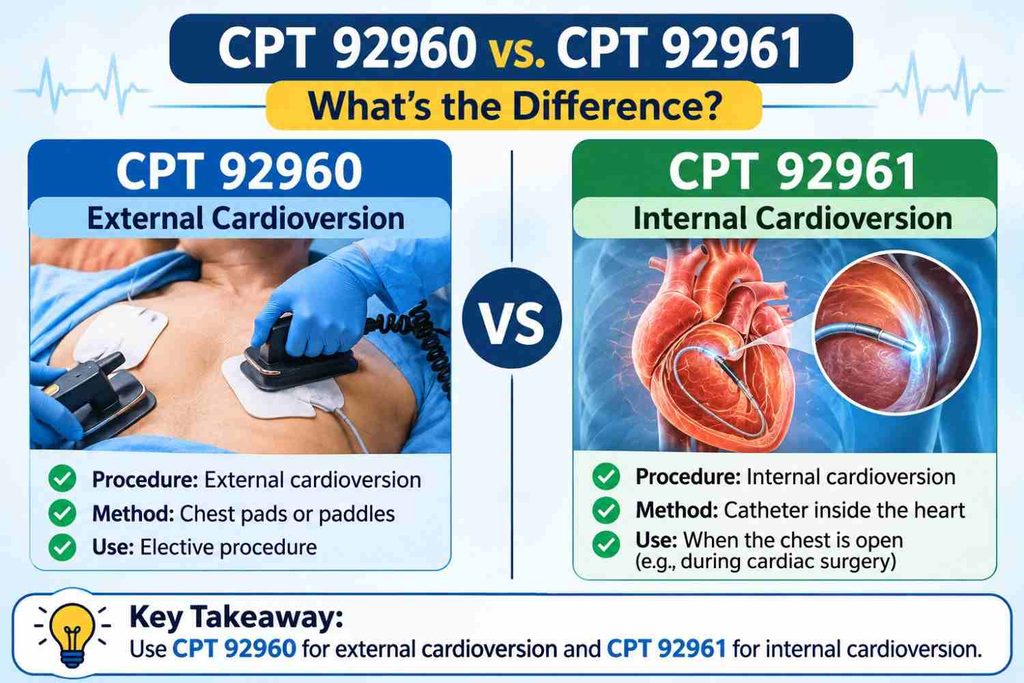
CPT 92960 vs. CPT 92961: What’s the Difference?
The difference is where the energy is delivered. 92960 is external and 92961 is internal.
| Comparison | CPT 92960 | CPT 92961 |
|---|---|---|
| Procedure | External cardioversion | Internal cardioversion |
| Method | Pads or paddles | Intracardiac electrical delivery |
| Electrode location | Outside the body | Within the heart |
| Descriptor | Elective, external | Elective, internal (separate procedure) |
Which Cardioversion Code Should You Choose?
Read the operative report and code what was actually done. Don’t pick a code just because the patient had open-heart surgery. Here’s a quick decision guide:
- Pads on the chest, synchronized shock? Report 92960.
- Catheter electrodes inside the heart? Consider 92961.
- Unsynchronized shock during arrest? That’s defibrillation, not cardioversion.
When Can You Bill CPT 92960?
You can bill it when a distinct, synchronized cardioversion is performed and documented.
Elective vs. Emergency Cardioversion
The emergency department setting doesn’t automatically block 92960. What matters is whether the service was a distinct cardioversion or part of emergency resuscitation. Document the indication and consent. Weak notes here are a classic reason claims get denied.
Cardioversion vs. Defibrillation
| Cardioversion | Defibrillation |
|---|---|
| Synchronized shock | Unsynchronized shock |
| Qualifying arrhythmias | Shockable cardiac rhythms |
| 92960 may apply | Not reported with 92960 |
Per the American College of Emergency Physicians’ (ACEP) January 2026 guidance, multiple shocks in one attempt are a single 92960.
ICD-10-CM Codes for Cardioversion
Your diagnosis code must match the documented arrhythmia and support medical necessity. Use the FY 2027 ICD-10-CM set, effective October 1, 2026. Brushing up on the basics? Start with what medical coding is.
| ICD-10-CM | Diagnosis |
|---|---|
| I48.0 | Paroxysmal atrial fibrillation |
| I48.11 | Longstanding persistent atrial fibrillation |
| I48.19 | Other persistent atrial fibrillation |
| I48.20 | Chronic atrial fibrillation, unspecified |
| I48.21 | Permanent atrial fibrillation |
| I48.3 / I48.4 | Typical / atypical atrial flutter |
| I47.10 / I47.19 | Supraventricular tachycardia, unspecified / other |
These are examples, not a list of universally covered diagnoses. SVT is a category (I47.1) that needs a more specific code, so don’t report I47.1 alone. Follow the documentation and your payer’s medical-necessity policy.
CPT 92960 Billing Guidelines
Review these rules before you submit. For the wider picture, see our cardiology billing guide.
Professional vs. Facility Billing
The physician bills a professional claim. Hospital outpatient departments and ambulatory surgery centers bill facility charges. Each pays under a different methodology, so place of service and claim type matter.
Multiple Shocks and Repeat Cardioversion
Several shocks in one attempt are one unit. Don’t bill extra units for extra joules. A later, separate attempt needs its own documentation and may need modifier 76 or 77.
Sedation and ECG Billing
Moderate sedation can be reported separately when its requirements are met. Pre- and intra-procedure ECGs are generally included. ACEP says a medically necessary post-procedure ECG may be reported with modifier 59.
Required Documentation for CPT 92960
Incomplete notes are one of the fastest ways to lose a cardioversion claim.
Essential Documentation Checklist
| Element | What to record |
|---|---|
| Diagnosis | Specific arrhythmia |
| Medical necessity | Why cardioversion was needed |
| Consent | Signed consent or documented discussion |
| Procedure | External synchronized cardioversion |
| Shocks | Number delivered and energy used |
| Sedation | Drug, dose, monitoring, if applicable |
| Outcome | Post-procedure rhythm and complications |
| Authentication | Provider’s signature |
Why Documentation Matters
Thin notes lead to medical necessity denials, coding discrepancies, audit risk, and slow payment.
Here’s an illustrative example, not a mandatory template: “Persistent AFib (I48.19), consent obtained. External synchronized shock, 120 J, then 150 J. Converted to NSR. Post-procedure ECG confirms rhythm. No complications.”
CPT 92960 Modifiers and NCCI Bundling Rules
Modifiers depend on the actual service, claim circumstances, and payer edits. None is automatic.
Common Modifiers to Review
| Modifier | Purpose |
|---|---|
| 25 | Significant, separately identifiable E/M service |
| 59 | Distinct procedural service |
| 76 | Repeat procedure, same physician |
| 77 | Repeat procedure, different physician |
NCCI Edits and Code Bundling
The National Correct Coding Initiative (NCCI) edits stop certain code pairs from being paid together. Check Column One and Column Two, and see whether a modifier is permitted for that pair. The CMS NCCI policy manual is a good starting point, but always check the current quarterly files. Never add modifier 59 just to push past a denial. The record must show a genuinely distinct service. Our CPT code updates guide can help you stay current.
Medicare Reimbursement for CPT 92960
No single number applies everywhere. Payment depends on the Physician Fee Schedule, relative value units (RVUs), locality adjustments, and professional vs. facility setting. Commercial payers follow their own contracts. Use the CMS Physician Fee Schedule Look-Up Tool for current figures, and verify the code, locality, and year.
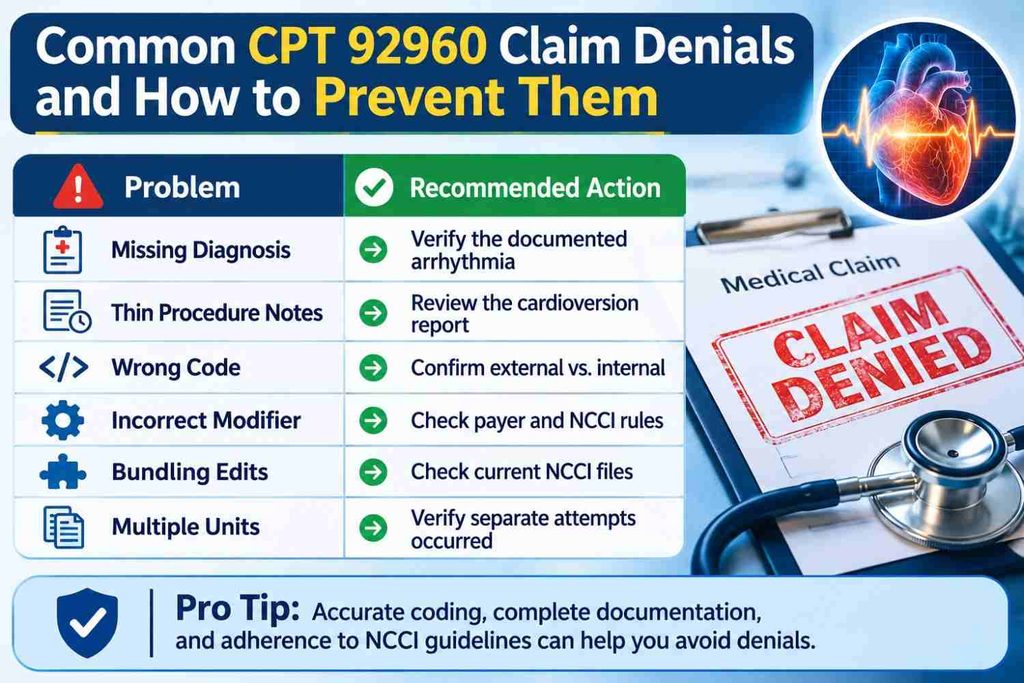
Common CPT 92960 Claim Denials and How to Prevent Them
| Problem | Recommended action |
|---|---|
| Missing diagnosis | Verify the documented arrhythmia |
| Thin procedure notes | Review the cardioversion report |
| Wrong code | Confirm external vs. internal |
| Incorrect modifier | Check payer and NCCI rules |
| Bundling edits | Check current NCCI files |
| Multiple units | Verify separate attempts occurred |
Picture a hypothetical practice that bills 92960 and a post-procedure ECG together with no modifier. The ECG line denies as bundled, and nobody notices for weeks. Pull the original record, find the denial reason, fix the coding, and send supporting documentation when needed. Then follow your appeal process, and see our denial management guide.
How Billr Health Helps Cardiology Practices
Our specialty-organized teams know cardiology. Our claim scrubbing uses 300+ validation rules to catch modifier conflicts and diagnosis pointer issues before payers see them, and our denial prediction engine flags risky claims. AI assists, and billing specialists decide.
| Billr Health client results* | Figure |
|---|---|
| First-pass claim acceptance | 98% |
| Reduction in claim denials | 42% |
| Average AR days (within 90 days) | 15 |
*Typical results based on Billr Health client data. Individual results vary.
Want to track what matters? See our RCM KPIs.
Frequently Asked Questions About Cardioversion CPT Code
What is the CPT code for external cardioversion?
CPT 92960 describes elective, external electrical cardioversion, meaning a planned, synchronized shock delivered through the chest wall to convert an abnormal rhythm, such as atrial fibrillation or flutter, toward normal sinus rhythm.
What is the difference between CPT 92960 and 92961?
CPT 92960 reports external cardioversion using pads or paddles on the chest, while CPT 92961 reports internal cardioversion with electrodes placed inside the heart. Choose based on the procedure actually performed, not the setting.
Can CPT 92960 be billed in the emergency department?
Yes. An emergency department can report 92960 when the service is a distinct, synchronized cardioversion with documented indication and consent, rather than a shock given during emergency resuscitation or cardiac arrest treatment.
Can multiple shocks be billed separately under CPT 92960?
No. Multiple shocks delivered during one cardioversion attempt generally count as a single unit of 92960. A separate, later attempt needs its own documentation and may require modifier 76 or 77.
Final Thoughts
Cardioversion billing comes down to four things: the right code, the right diagnosis, airtight documentation, and modifiers that tell the truth. Get those right and most denials never happen. Verify against current AMA CPT, CMS NCCI, and payer policies each quarter, because rules change. If you’d rather not chase edits yourself, request a free revenue audit. We’ll review your last 90 days of claims, denials, and AR and show you where revenue is leaking. No pressure, no obligation. For more, explore medical billing vs. medical coding and how to reduce AR days.

Billr Health was founded by healthcare revenue cycle veterans who spent years inside billing departments, clearinghouses, and payer organizations — and saw exactly where the revenue was being lost. We built the company we wished had existed when we were on the other side of this problem. Our founders spent years working inside billing departments, RCM companies, clearinghouses, and payer organizations. They saw the same problems across every practice they worked with — staff overwhelmed by claim volume, denials not being appealed, AR aging without anyone noticing, coding that was systematically leaving money behind.