
Ever sent a perfectly good therapy claim and watched it bounce over two tiny characters? That’s the modifier problem. Mental health billing modifiers are short codes that add context to a CPT or HCPCS code: who delivered the service, how, and under which program. Pick the wrong one and your psychiatry or behavioral health claim gets rejected or delayed, which hurts mental health insurance reimbursement. Here’s a simple workflow to get it right.

What Are Mental Health Billing Modifiers?
Think of a procedure code as a sentence and the modifier as its punctuation. It doesn’t change the words, but it changes the meaning. A modifier never replaces the procedure code or the ICD-10-CM diagnosis.
Don’t mix up these three:
- CPT modifiers (maintained by the AMA): 25, 59, 93, 95
- HCPCS Level II modifiers (maintained by CMS): GT, HO, HN, AJ
- Place of Service (POS) codes: two-digit location codes, not modifiers
Each modifier answers one of four questions: who provided the service, what was distinct about it, how it was delivered, and which program rule applies. Need a refresher on the basics? Start with what medical coding actually involves.
Common Mental Health Billing Modifiers and Their Uses
Requirements depend on the code, provider, payer, and setting. Treat this as a map, not a billing instruction.
Quick Reference Table: Common Mental Health Modifiers
| Modifier | General description | Verify before billing |
|---|---|---|
| 25 | Significant, separately identifiable E/M service | E/M is distinct from other same-day services |
| 59 | Distinct procedural service | No more specific modifier applies; documentation supports it |
| 95 | Synchronous audio-video telemedicine | Payer’s telehealth modifier and POS rules |
| 93 | Synchronous audio-only telemedicine | Audio-only coverage and documentation rules |
| GT | Interactive audio-video telehealth (HCPCS) | Whether the payer still requires GT |
| HO | Master’s-degree-level provider, in applicable programs | Provider eligibility; state/program policy |
| HN | Bachelor’s-degree-level provider, in applicable programs | Provider eligibility; state/program policy |
| AJ | Clinical social worker, in applicable programs | Payer’s exact definition |
| HQ | Group setting, in applicable programs | Code and payer permit HQ |
| HE | Mental health program, in applicable programs | Program requires HE |
Which Modifiers Should Mental Health Billers Prioritize?
Learn 25, 59, 93, and 95 first. They turn up across psychotherapy CPT modifiers and psychiatry workflows. HO, HN, AJ, HE, and HQ need a closer look at payer and program rules, since they don’t apply to every practice.
One trap: psychiatry visits often pair an E/M with a psychotherapy add-on code like 90833, so don’t assume Modifier 25 is required. Our psychiatry billing codes, modifiers, and pitfalls guide digs deeper.
Provider-Level Modifiers in Behavioral Health Billing
HO, HN, AJ, and Other Provider Designations
Some Medicaid and behavioral health programs use modifiers to show who rendered the service. Definitions and eligible provider types vary by state and payer, so one state’s HO rule isn’t another’s.
The modifier must match the provider’s license, enrollment, taxonomy, and payer credentialing record. Picture this: a clinic bills a session with a program modifier, but the payer’s file lists a different credential. The modifier looks right, yet the claim contradicts the record, and it’s denied. Before submitting, confirm the rendering provider meets the payer’s requirements for the billed service. Medicaid credentialing is often where these mismatches start.
Telehealth Modifiers in Mental Health Billing
Modifier 95 vs. 93 vs. GT
- 95: synchronous audio-video telemedicine
- 93: synchronous audio-only telemedicine
- GT: an HCPCS telehealth modifier some payer programs still require
Don’t treat 95 and GT as interchangeable. A payer that wants one may reject the other.
POS matters too. CMS says to use POS 10 when telehealth is provided in the patient’s home and POS 02 when it’s provided elsewhere. Here’s the typical Medicare pairing:
| Scenario | Modifier + POS |
|---|---|
| Video session, patient at home | 95 + POS 10 |
| Video session, patient elsewhere | 95 + POS 02 |
| Audio-only session, patient at home | 93 + POS 10 |
Rural health clinics and FQHCs may use FQ for audio-only mental health services. Medicaid and commercial plans set their own rules, so check current policy. Our telehealth billing guide tracks the changes.
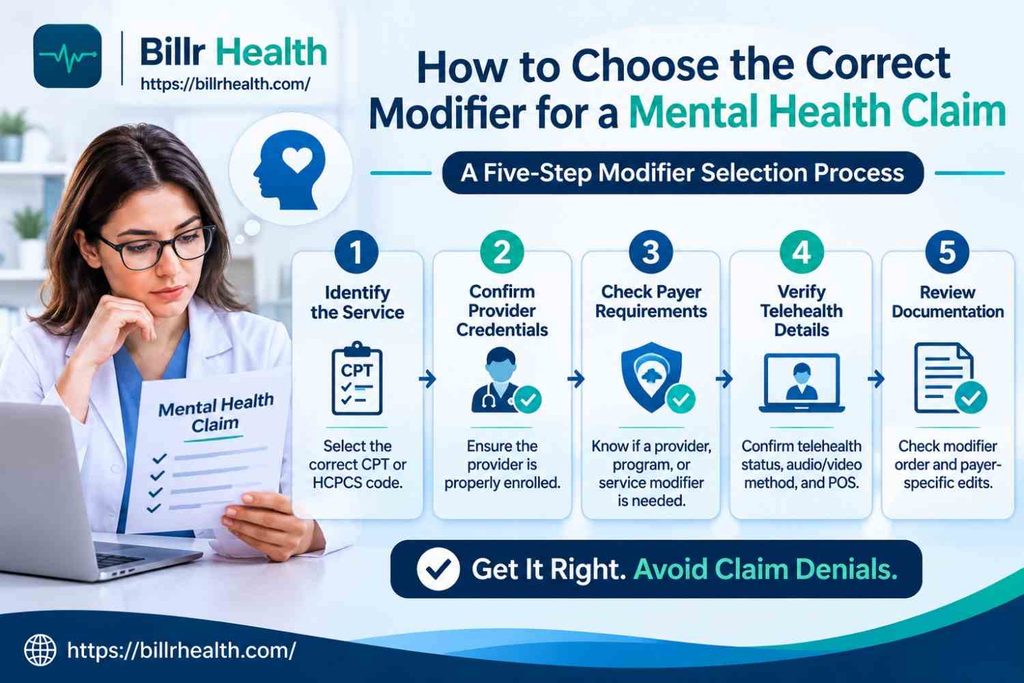
How to Choose the Correct Modifier for a Mental Health Claim
A Five-Step Modifier Selection Process
- Identify the service and select the correct CPT or HCPCS code.
- Confirm the rendering provider’s credentials and enrollment.
- Check whether the payer requires a provider, program, or service modifier.
- Confirm telehealth status, audio/video method, and POS.
- Review documentation, modifier order, and payer-specific claim edits.
Your decision path: Service code → Provider eligibility → Payer rule → Modifier selection → Documentation check → Claim submission
Common Mental Health Modifier Billing Errors and How to Fix Them
| Common mistake | Why it’s a problem | Fix |
|---|---|---|
| Wrong telehealth modifier | Claim may not meet payer rules | Verify audio/video rules and POS |
| Modifier 25 without a distinct E/M | Documentation may not support it | Document the separate E/M work |
| Misusing Modifier 59 | May improperly bypass a code edit | Check NCCI edits; use XE, XP, XS, or XU when appropriate |
| Missing provider-level modifier | Claim doesn’t identify the provider category | Match credentials and enrollment rules |
| Outdated state Medicaid rule | Claim fails current requirements | Check the latest state provider manual |
| Unsupported modifier | Record doesn’t justify the claim | Review documentation first |
Manual checks miss things. That’s why Billr Health’s claim scrubbing flags modifier conflicts and diagnosis pointer issues before submission.
Documentation and Payer Verification Checklist
What Should Be Checked Before Claim Submission?
- Correct CPT/HCPCS code and ICD-10-CM diagnosis
- Service date, duration, and clinical notes
- Provider’s license, NPI, taxonomy, and credentialing status
- Modifier rules in the payer’s current billing manual
- Telehealth modality and POS
- Authorization and eligibility verification
- NCCI edits and payer-specific rules
Documentation must support the service actually performed, not just the modifier you picked.
Do Mental Health Billing Modifiers Vary by State and Insurance?
Medicare, Medicaid, and Commercial Payer Differences
Yes. They vary a lot.
- Medicare: follow CMS rules and your Medicare Administrative Contractor’s guidance.
- Medicaid: review the state agency and managed-care plan manuals.
- Commercial: check each payer’s provider manual and contract.
A modifier one payer accepts may be invalid, or unnecessary, for another. When claims fail, our guide to why claims get denied helps you trace the cause.
Frequently Asked Questions About Mental Health Billing Modifiers
What are the most common mental health billing modifiers?
Commonly encountered modifiers include 25, 59, 93, 95, and GT, plus program-specific ones like HO, HN, AJ, HQ, and HE. Applicability depends on the payer, provider type, and service billed.
What is the difference between Modifier 93 and Modifier 95?
Modifier 95 reports a synchronous telemedicine service delivered through real-time audio and video. Modifier 93 reports a synchronous telemedicine service delivered by audio only. Payers decide which one they accept, so verify first.
What does the HO modifier mean in mental health billing?
HO is an HCPCS modifier many Medicaid and behavioral health programs use to flag a master’s-degree-level provider. Definitions and eligible provider types vary, so confirm your state or payer’s policy before billing.
When should Modifier 25 be used for mental health services?
Use Modifier 25 when a patient receives a significant, separately identifiable E/M service on the same day as another procedure or service. Documentation must clearly show the E/M work went beyond the other service.
Can mental health billing modifiers vary by state?
Yes. Medicare follows CMS and its contractors, while Medicaid varies by state agency and managed-care plan. Commercial insurers set their own rules, so a modifier valid for one payer may be wrong for another.
Final Thoughts: Improve Mental Health Claim Accuracy With the Right Billing Process
Accurate modifiers come down to a repeatable habit: confirm the service, verify the provider, check the payer rule, and make sure the notes back it up. That habit prevents avoidable denials and keeps revenue steadier. If you’d rather not chase payer rules yourself, Billr Health supports psychiatry and behavioral health billing practices.

Billr Health was founded by healthcare revenue cycle veterans who spent years inside billing departments, clearinghouses, and payer organizations — and saw exactly where the revenue was being lost. We built the company we wished had existed when we were on the other side of this problem. Our founders spent years working inside billing departments, RCM companies, clearinghouses, and payer organizations. They saw the same problems across every practice they worked with — staff overwhelmed by claim volume, denials not being appealed, AR aging without anyone noticing, coding that was systematically leaving money behind.