
Ever submitted a Medicaid application, waited weeks, then got rejected over one missing page? It’s maddening, and it’s common. Provider credentialing for Medicaid means verifying your licenses and background, then enrolling you with your state program so you can bill for Medicaid patients. Most providers need that approval before submitting claims, and managed care plans often add steps. Below: the checklist, screening rules, timeline factors, and revalidation basics behind smooth Medicaid provider enrollment. Prefer to delegate? Our provider credentialing service handles it.
What Is Provider Credentialing for Medicaid?
Provider credentialing for Medicaid is the verification of a provider’s licenses, training, and background, paired with enrollment in a state Medicaid program. It confirms you meet program requirements before billing for covered services.
Think of it like getting a driver’s license, then registering your car. One proves you’re qualified; the other puts you in the system. The Centers for Medicare & Medicaid Services (CMS) sets federal rules, while each State Medicaid Agency (SMA) runs enrollment for Medicaid and CHIP.
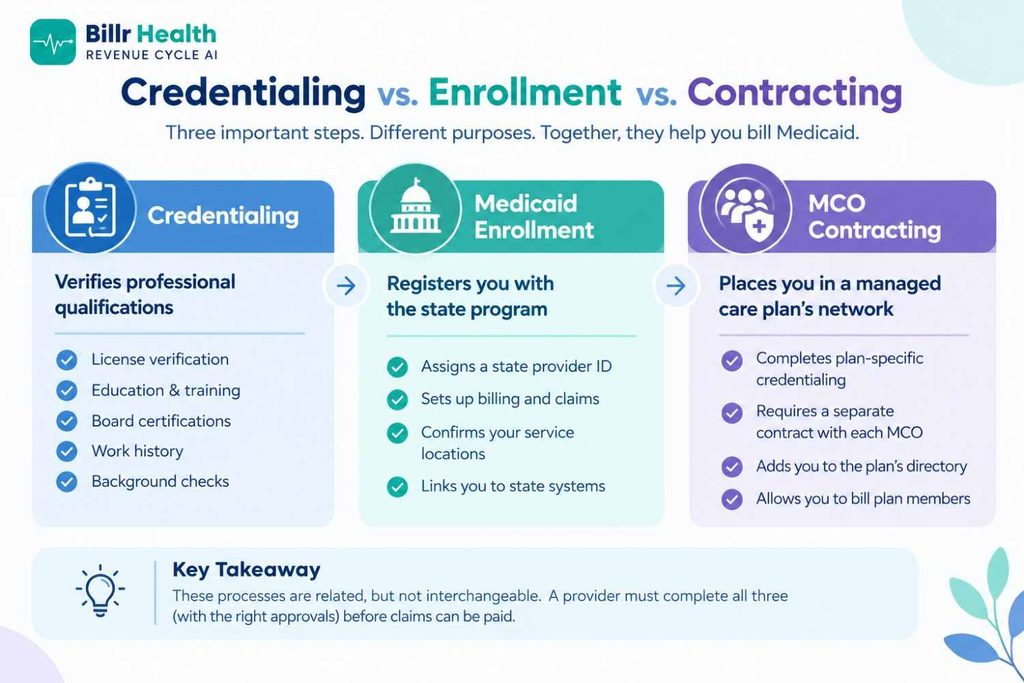
Credentialing vs. Enrollment vs. Contracting
| Process | Main purpose |
|---|---|
| Credentialing | Verifies professional qualifications |
| Medicaid enrollment | Registers you with the state program |
| MCO contracting | Places you in a managed care plan’s network |
Related, not interchangeable. Our medical credentialing guide covers the basics.
What Are the Medicaid Provider Credentialing Requirements?
Your checklist depends on your state, provider type, and enrollment pathway, but most applications request these items:
Identification and Tax Information
- NPI (issued through NPPES)
- TIN or EIN, plus a W-9
- Personal details where required
Licenses, Certifications, and Insurance
- Active state license and board certifications
- Training verification
- DEA registration for prescribers
- Malpractice coverage, when required
Ownership, Banking, and Compliance
- Ownership and control disclosures
- Practice locations and group affiliations
- EFT banking details
- Consent to Office of Inspector General (OIG) and SAM.gov exclusion checks
Some institutional providers must also pay a federal application fee, which is $750 in 2026. Individual practitioners and physician groups are generally exempt, but confirm with your state.
How Does the Medicaid Credentialing Process Work?
Step 1: Find Your State’s Requirements
Locate your official SMA website and confirm forms, fees, provider category, and pathway.
Step 2: Prepare and Submit
Verify identifiers, licenses, addresses, ownership details, and attachments, then submit through the state portal.
Step 3: Complete Screening
The state verifies your license, runs database checks, and applies risk-based screening.
Step 4: Respond and Confirm Approval
Answer clarification requests quickly. Before billing, confirm your status, effective date, and billing information.
Step 5: Handle Managed Care
Joining MCO networks? Check each plan’s rules. Our CAQH profile guide helps.
Picture a three-provider therapy clinic whose application lists a taxonomy code that doesn’t match its services. The state returns it, and claims stall for weeks. A five-minute identifier check prevents that, which matters especially for behavioral health billing.
What Are the Federal Medicaid Provider Screening Levels?
Under 42 CFR Part 455, § 455.450, states classify providers as limited, moderate, or high risk. Your state assigns the category, so don’t guess from your job title.
| Risk level | Screening |
|---|---|
| Limited | License verification and required database checks |
| Moderate | Limited checks plus site visits |
| High | Moderate checks plus criminal background checks and fingerprinting |
States may add their own requirements.
How Long Does Medicaid Credentialing Take?
There’s no universal answer. Anyone promising a fixed 60–120 days for every state is guessing. Timing depends on:
- State workload and review procedures
- Provider type and risk category
- Application completeness and credential verification
- Site visits, background checks, and follow-ups
- Extra MCO credentialing
Check your state portal for current guidance, and see our breakdown of how long credentialing takes.
How Does Managed Care Credentialing Differ From State Enrollment?
State enrollment gets you into the program. MCO credentialing gets you into a specific plan’s network. It’s like having a passport but no boarding pass.
- Fee-for-service: You bill the state once enrollment requirements are met.
- Managed care: You may need separate credentialing and contracting with each plan, plus provider directory details and CAQH ProView where accepted.
CAQH never replaces the state application. Once you’re in-network, eligibility verification keeps claims clean.
What Is Medicaid Provider Revalidation?
Revalidation confirms enrolled providers still meet program rules. Under 42 CFR § 455.414, states must revalidate at least every five years, and some providers face earlier reviews. Expect to:
- Update licenses and certifications
- Review ownership disclosures
- Confirm practice locations
- Complete screening and submit requested documents
- Track deadlines and state notices
Miss one, and your enrollment status is at risk.
What Are the Most Common Medicaid Credentialing Mistakes?
| Mistake | Prevention |
|---|---|
| Expired license information | Verify active credentials first |
| Wrong NPI or taxonomy | Match identifiers to provider and service |
| Missing ownership disclosures | Review every disclosure requirement |
| Incomplete documents | Use your state’s checklist |
| Ignored follow-ups | Monitor the portal; respond promptly |
| Missed revalidation | Track due dates |
| Assuming state enrollment covers every MCO | Confirm each plan’s requirements |
These slip-ups cause avoidable delays, and delays become denials. See the top reasons claims get denied.
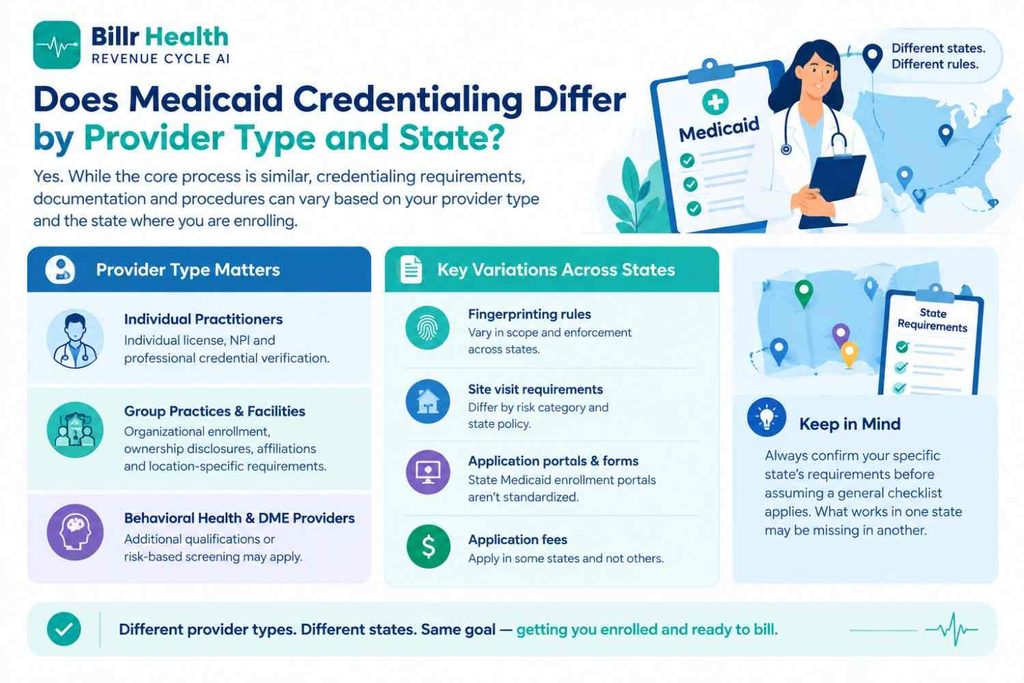
Does Medicaid Credentialing Differ by Provider Type and State?
Yes. Individual practitioners focus on licenses, NPIs, and credential verification. Groups and facilities add organizational enrollment, ownership disclosures, and location rules. Behavioral health and DME providers may face extra qualifications or higher screening. Because portals and forms vary by state, confirm requirements with your agency. Running a small practice? Start with our billing survival guide.
Important Reads:
Provider Credentialing for a Health Plan
Provider Credentialing for BCBS
Frequently Asked Questions About Provider Credentialing for Medicaid
What Is the Difference Between Medicaid Credentialing and Enrollment?
Credentialing verifies your qualifications, such as licenses and training. Enrollment registers you with the state Medicaid program. The steps often overlap operationally, but each serves a different purpose and produces a different approval.
Can a Provider Bill Medicaid Before Enrollment Is Approved?
Generally, no. You need the appropriate enrollment and participation approvals first. Some states allow retroactive effective dates, others don’t, so check your state’s rules on effective dates before treating Medicaid patients.
How Often Must Medicaid Providers Revalidate Their Enrollment?
Federal rules require states to revalidate providers at least every five years. Your state may require earlier reviews or additional documentation, so watch for notices and calendar your deadlines well in advance.
Does Medicaid Credentialing Vary by State?
Yes. Each State Medicaid Agency sets its own portals, forms, documentation, and screening procedures within federal rules. Always confirm current requirements with your state agency instead of relying on a generic checklist.
Is CAQH Required for Medicaid Credentialing?
Not for state enrollment. CAQH ProView may support managed care credentialing where a plan accepts it, but it never replaces your state Medicaid enrollment application. Check each plan’s requirements individually.
Final Thoughts: Your Pre-Submission Checklist
Provider credentialing for Medicaid rewards the prepared. Know your state’s rules, gather documents early, respond fast, and watch revalidation dates, and you’ll start billing sooner. Before submitting, check that you’ve:
- Confirmed your provider category and state requirements
- Gathered identifiers, licenses, and disclosures
- Completed screening steps
- Tracked the application and answered requests
- Verified approval and MCO requirements
- Calendared revalidation deadlines
At Billr Health, AI handles the volume work while experienced specialists handle judgment-heavy tasks like credentialing. Ready to skip the paperwork ping-pong? Talk to our team, review pricing, or explore our revenue cycle management services.