
Ever tried to join a Blue Cross Blue Shield network and felt like you were assembling furniture without the manual? You’re not alone. Provider credentialing for BCBS is how a Blue plan verifies your license, training, and work history before it lets you treat its members in-network. The twist: there’s no single “BCBS.” This guide covers eligibility, documents, steps, timelines, and the slip-ups that quietly stall applications.
Billr Health’s founders bring 15 years in healthcare revenue cycle management (James Mercer) and 12 years in behavioral health billing (Alicia Reyes, CPC). The tips below come from the problems we see most.
What Is Provider Credentialing for BCBS?
Credentialing is the verification of a clinician’s license, education, training, and professional history. The Blue Cross Blue Shield Association (BCBSA) represents independent, locally operated companies, so each plan runs its own application. Think regional franchises: same logo, different kitchen. Many plans also align their programs with accreditation standards from NCQA and URAC.
Want the big-picture basics first? Read our medical credentialing process guide.
Credentialing vs. Enrollment vs. Contracting
These three get mixed up constantly. Approval in one doesn’t finish the others.
| Process | Main purpose |
|---|---|
| Credentialing | Verifies your qualifications and credentials |
| Provider enrollment | Registers your details with the payer |
| Contracting | Sets participation terms and rates with the plan |
Public programs follow their own rules. See our guide to provider credentialing for Medicaid for that side.
Who Can Apply for BCBS Provider Credentialing?
Licensed physicians, nurse practitioners, physician assistants, therapists, and other eligible practitioners can apply. Eligibility depends on the plan, your specialty, your state, and whether the network needs your specialty in your area. Facilities and groups often have extra steps.
Tip: Before you build a full application, ask the plan whether it’s accepting your specialty and location. Behavioral health clinicians, see our behavioral health billing guide for what comes after approval.
Basic Eligibility Requirements
- An active license from your state medical licensing board
- Training that supports your requested specialty
- Professional liability insurance, when required
- A clean professional history and any plan-specific criteria
Documents Required for BCBS Credentialing
Your exact checklist varies by plan and provider type. Anthem, one of the largest Blue companies, publishes a clear example: five years of work history in month/year format, current liability insurance, DEA or CDS certificate where applicable, hospital privileges, and a site review within 30 days of request, if one applies.
| Document | Why it’s needed |
|---|---|
| State license | Confirms authority to practice |
| NPI (issued through NPPES) | Identifies you in billing transactions; see CMS’s NPI standard |
| CAQH profile and attestation | Shares your professional data with the plan |
| CV and work history | Supports employment verification |
| Board certification and education | Verifies specialty qualifications |
| Malpractice certificate | Confirms liability coverage |
| DEA or CDS registration | Needed if you prescribe controlled substances |
| W-9 | Supports tax and payment setup |
| Hospital privileges | Required for some specialties |
Pre-Submission Document Checklist
- Check every expiration date.
- Make names, addresses, and NPIs match across all records.
- Explain work-history gaps before anyone asks.
- Sign everything and upload it in the required format.
How to Complete the BCBS Provider Credentialing Process
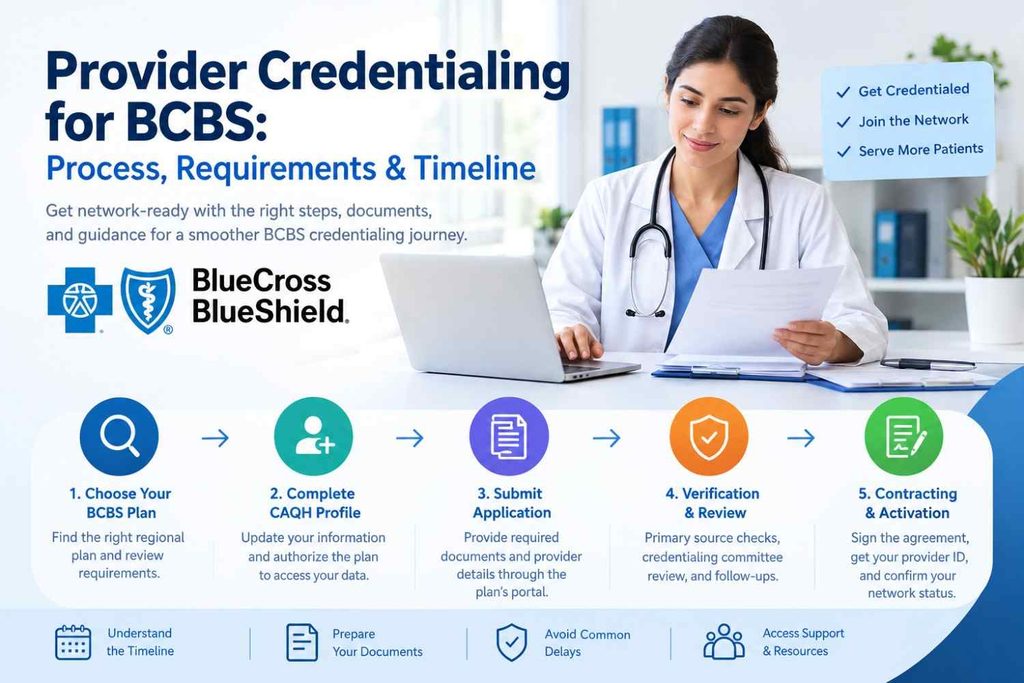
Here’s the short answer: find your plan, update CAQH, apply, respond fast, then confirm your effective date. Let’s walk it.
Step 1: Identify the Correct BCBS Plan
Find the Blue company serving your practice location. Open its official provider site and confirm eligibility, specialty availability, and how to submit.
Step 2: Register for or Update CAQH
The CAQH Provider Data Portal (formerly CAQH ProView) stores your professional data in one place. Complete every section, upload documents, attest, and authorize the right plan to view it. Many plans use CAQH, but don’t assume every BCBS plan requires it. Our CAQH profile setup guide shows how.
Step 3: Submit the Network Participation Request
Follow the regional plan’s instructions. Supply your specialty, locations, group, NPI, and tax details. Ask whether group enrollment needs separate paperwork.
Step 4: Complete Verification and Respond Quickly
The plan performs primary source verification of your license, education, and other credentials. It may also check the National Practitioner Data Bank (NPDB). Answer every request promptly and keep copies of everything.
Step 5: Complete Contracting and Confirm Activation
Sign your agreement, then confirm your effective date, locations, and identifiers. Check claims requirements through the plan’s portal. Many plans use Availity for this.
How Long Does BCBS Provider Credentialing Take?
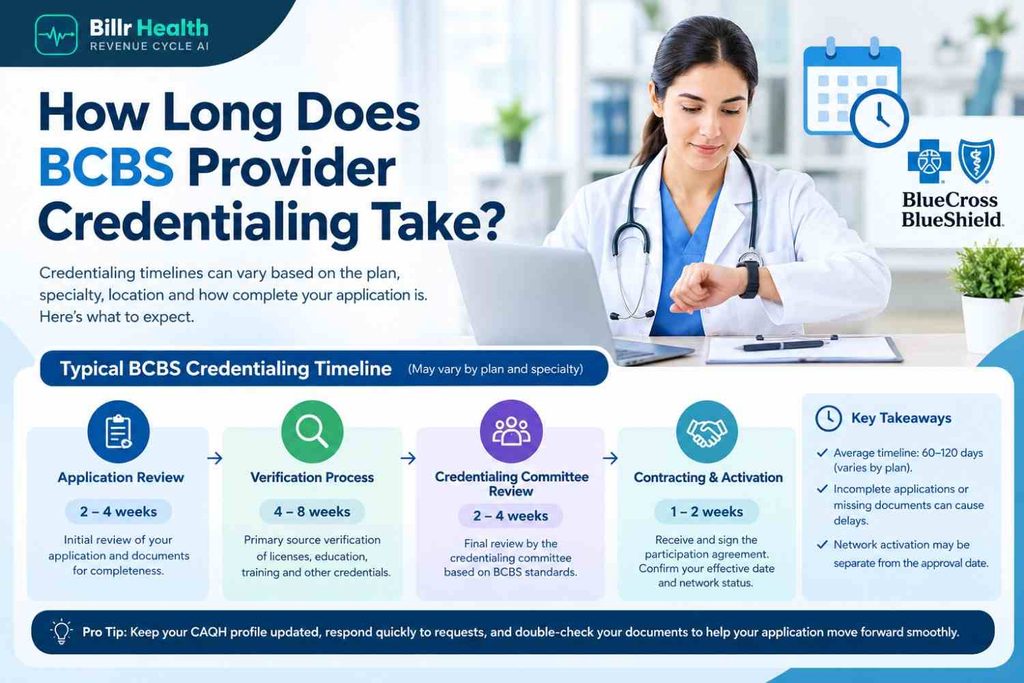
It depends on the plan, but Anthem’s published estimate is a useful benchmark: about 45 days after the credentialing department receives your completed CAQH application. That’s one plan, not a universal BCBS deadline.
| Timeline reference | What’s published |
|---|---|
| Anthem (multiple states) | Typically 45 days from a completed CAQH application |
| Anthem Indiana | Notice within five business days if an application is incomplete |
| Other BCBS plans | Follow that plan’s own published timeline |
| Network activation | Confirm the effective date separately |
For more, see our credentialing timeline breakdown.
What Can Delay Approval?
- Expired or incomplete CAQH information
- License, work-history, or insurance mismatches
- Slow responses from outside verification sources
- Extra plan requirements or limited network openings
How to Check Your BCBS Credentialing Status
You have a right to ask. Anthem, for example, lets providers request the status of a credentialing application.
- Save your confirmation or application number.
- Check the plan’s provider portal.
- Contact the credentialing department through official channels.
- Ask what’s outstanding, pending, or decided.
- Write down who you spoke with and when.
How to Avoid Credentialing Delays or Denials
Picture this (an illustrative example): a therapist submits a perfect application, but her CAQH attestation lapsed two weeks earlier. The plan pauses the file and waits. Nobody tells her loudly. Weeks vanish. It’s the paperwork version of a lapsed parking meter.
| Common problem | Fix |
|---|---|
| Incomplete application | Review every required field before you submit |
| Expired CAQH attestation | Re-attest on schedule |
| Mismatched details | Reconcile names, addresses, NPIs, and tax IDs |
| Unanswered requests | Assign one owner and track deadlines |
| Unclear status | Follow up with the official contact |
A delay isn’t a denial. If you’re denied, ask the plan for the specific reason and its correction or appeal process. Claim denials are a different battle; see our top reasons claims get denied.
What Happens After BCBS Credentialing Approval?
Approval doesn’t equal payment. Confirm your agreement, effective date, participating locations, identifiers, and directory listing. Then build clean workflows: verify coverage with insurance eligibility verification and catch errors early with claim scrubbing.
BCBS Provider Recredentialing Requirements
Expect periodic recredentialing. Anthem recredentials network providers every three years, and in Colorado, failing to update CAQH or supply required information by the due date can lead to administrative termination. That’s plan-specific, so follow your own plan’s notices.
Important Reads:
Provider Credentialing for a Health Plan
Frequently Asked Questions
Is CAQH required for BCBS credentialing?
Not always. Many plans, including Anthem, use CAQH for credentialing, but requirements differ by regional BCBS company. Check your plan’s official provider page before building a profile, so you don’t waste effort.
How long does provider credentialing for BCBS take?
It varies by plan. Anthem states its process typically takes 45 days after receiving a completed CAQH application. Other Blue plans publish different timelines, and incomplete applications or slow verifications can extend the wait.
Can a group practice apply for BCBS credentialing?
Yes, but group participation and individual practitioner credentialing often involve separate steps. Many plans want each clinician credentialed and the group contracted, so confirm both requirements with your regional plan.
Can I bill BCBS while credentialing is pending?
Don’t assume so. Billing in-network before your effective date can lead to denials or out-of-network treatment. Confirm your participation date and billing rules in writing with the plan before scheduling its members.
What should I do if my BCBS credentialing application is denied?
Ask for the denial reason in writing, correct any fixable issues, and request the plan’s reconsideration or appeal process. Anthem recognizes providers’ right to review and correct credentialing information submitted.
Simplify Your Credentialing and Billing with Billr Health
Credentialing is paperwork plus patience. Billr Health helps practices keep documents organized, follow up on time, and connect credentialing with billing workflows. We don’t promise guaranteed approvals, just fewer dropped balls. Not sure what to look for in a partner? Use our medical billing company checklist, then talk to Billr Health about your needs.
Final Thoughts
Provider credentialing for BCBS isn’t hard, but it is detail-heavy. Pick the right regional plan, keep CAQH current, match every record, and follow up like it’s your job. Once you’re in-network, protect that status with clean billing and a strong revenue cycle; our revenue cycle management pillar guide is a good next read.