
You finished training, opened your practice, and now patients keep asking, “Do you take my insurance?” Before you can say yes, you need provider credentialing for a health plan. Think of it as a background check and a job interview rolled into one, run by the insurer. Get it wrong, and you could treat patients for weeks without a clear path to payment. Here’s how the requirements, process, timelines, and common delays actually work.
What Is Provider Credentialing for a Health Plan?
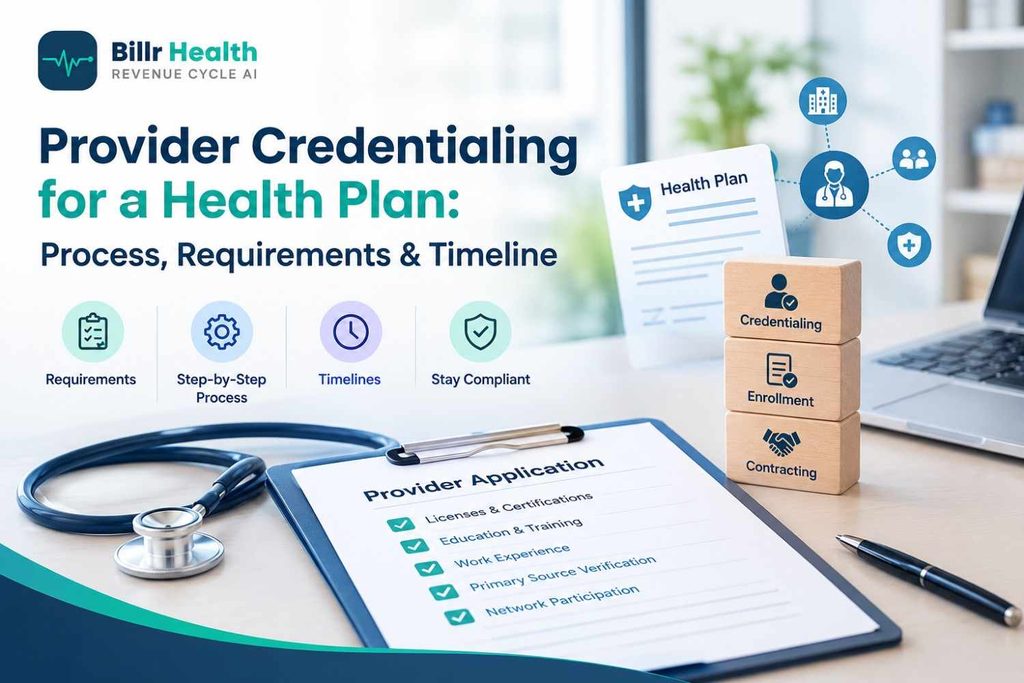
Provider credentialing for a health plan is the insurer’s review of a practitioner’s licenses, training, work history, and professional standing to decide whether that provider can join its network. Plans may do this in-house or use a credentialing verification organization (CVO).
Rules vary by payer, provider type, and state. Many plans follow NCQA credentialing standards, which cover primary source verification, committee review, and ongoing monitoring. If you’re new to the basics, our medical credentialing process guide walks through the big picture.
What Are the Requirements for Health Plan Credentialing?
Gather your paperwork before you apply. It’s like packing for a trip: you don’t want to hunt for your passport at the airport.
Documents and Information Providers Should Prepare
- Active state professional license
- Individual or organizational NPI, as applicable
- Education, training, and board certification records
- Work history and professional references
- Malpractice insurance and claims history, when required
- DEA or state controlled-substance registration, where relevant
- Practice locations, specialties, hospital affiliations, and contact details
- Completed application, attestations, and supporting documents
Does Every Health Plan Require the Same Documents?
Nope. Requirements shift by specialty, payer, state, and provider category. Always check the plan’s official provider application and credentialing policy. Our guides on BCBS credentialing and Medicaid credentialing show how differently payers can operate.
How Does the Health Plan Credentialing Process Work?
The insurance payer credentialing process boils down to five steps, from preparation to a usable network status.
Step 1: Select the Health Plan and Review Its Requirements
Confirm the payer accepts your specialty, location, and requested network type before you apply. Applying blindly can waste weeks.
Step 2: Complete the Application and CAQH Profile
Many plans use CAQH to access your professional data. Finishing your profile and authorizing plans doesn’t equal approval, so keep it accurate. Our CAQH profile guide shows how.
Step 3: Complete Primary Source Verification
The payer or its verification partner checks licenses, education, training, board certification, work history, malpractice information, and sanctions (such as NPDB and OIG exclusion checks) directly with the original sources.
Step 4: Payer Review and Credentialing Decision
The plan reviews your verified file, may ask for missing details, then approves or denies. Answer requests fast.
Step 5: Complete Contracting and Confirm Network Status
You may still need to negotiate and sign a contract, then confirm your effective date and system setup. Don’t treat the application as done until then.
Credentialing vs. Provider Enrollment vs. Contracting
These three get mixed up constantly, and their order depends on the payer and program.
| Process | Main purpose | Typical outcome |
|---|---|---|
| Credentialing | Verify qualifications and professional standing | Credentialing decision |
| Provider enrollment | Register provider details in a payer’s or program’s systems | Enrollment or billing setup |
| Network contracting | Establish participation terms | Signed agreement |
Here’s the catch: credentialing approval alone doesn’t guarantee a signed contract, an active effective date, or payable claims. Medicare enrollment through CMS is also separate from commercial plan credentialing.
How Long Does Provider Credentialing for a Health Plan Take?
It depends on the payer, how complete your application is, how fast verification sources respond, your provider type, and state rules. There’s no universal industry clock. Cigna Healthcare publishes one real example (checked October 2026):
| Stage | Published timeframe | Source |
|---|---|---|
| Cigna credentialing | Typically 45–60 days after receiving the application packet | Cigna Healthcare |
| Directory and claims-system updates after approval | Typically within 10 business days | Cigna Healthcare |
These figures describe Cigna’s stated process, not every plan. Submit complete records early, answer requests promptly, and confirm your effective date before billing as in-network. For more, see our credentialing timeline guide.
Why Do Health Plan Credentialing Applications Get Delayed?
Usually because of small, avoidable mistakes.
Common Causes of Delays
- Missing documents or incomplete attestations
- Expired licenses or inconsistent provider information
- Slow replies from licensing boards, schools, or references
- Wrong practice locations, taxonomy codes, or NPI details
- Unanswered payer requests and unclear application status
Picture a clinic that lists Suite 200 on CAQH but Suite 210 on the application. The payer can’t match the records, so the file sits in limbo. That’s a hypothetical, but mismatches like this are a classic stall.
How to Reduce Credentialing Delays
Keep a document checklist, use identical provider details everywhere, set calendar reminders, follow up regularly, and track application dates, open items, and payer responses in one tracker. Nothing guarantees faster approval, but organization removes the self-inflicted delays.
What Happens After Credentialing Approval?
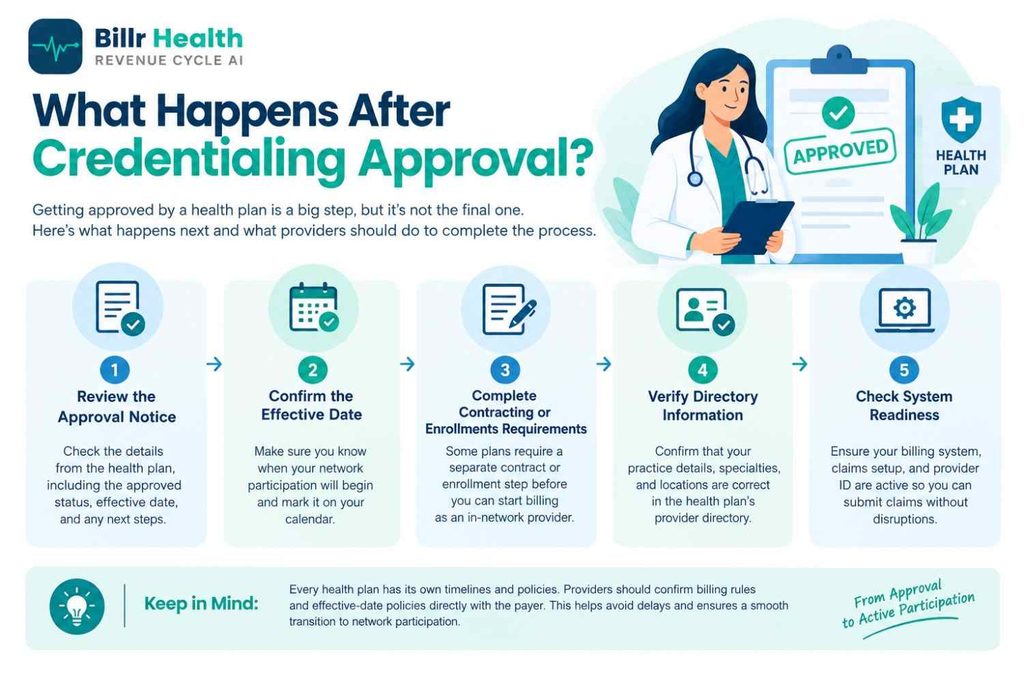
Approval is a milestone, not the finish line. Review your approval notice, confirm the effective date, finish any contracting or enrollment tasks, verify your directory listing, and check that the payer’s systems are ready.
Billing rules and effective-date policies differ, so confirm them directly with the plan. Don’t assume retroactive billing. Before your first claim, run eligibility verification, because skipped checks feed the top reasons claims get denied.
How Does Recredentialing Help Maintain Health Plan Participation?
Credentialing doesn’t end at approval. Plans periodically reverify qualifications and monitor sanctions, complaints, and license status. Keep CAQH and payer records current, watch expiration dates, and answer recredentialing notices on time. Intervals differ by plan, so check yours.
Frequently Asked Questions
What Is Provider Credentialing for a Health Plan?
It’s the process where a health plan verifies a provider’s licenses, training, work history, and professional standing before deciding whether that provider can join the plan’s network and treat its members.
Can I Use CAQH for Multiple Health Plans?
Often, yes. Participating plans can access your shared CAQH information once you complete your profile and give authorization. Individual payers may still require their own applications, so confirm each plan’s specific requirements.
Does Credentialing Approval Mean I Can Start Billing?
Not necessarily. Approval alone may not be enough, so confirm your signed contract, enrollment status, effective date, and the payer’s billing requirements before submitting any claims as an in-network provider.
How Can I Check My Credentialing Application Status?
Check the payer’s provider portal first. If you can’t find an update, contact the credentialing team with your application reference number and provider details, such as your NPI and practice name.
What Should I Do If My Application Is Delayed?
Confirm the payer received your application, ask which items are missing, respond to every request quickly, and document each follow-up date and contact name so you can escalate with a clear record.
Simplify Your Provider Credentialing Workflow
Juggling applications, CAQH updates, and payer follow-ups on top of patient care is a lot. Billr Health’s provider credentialing services and medical billing support can help you organize documentation, track applications, and follow up on outstanding requirements. Ready to talk it through? Contact our team.
Final Thoughts
Provider credentialing for a health plan isn’t glamorous, but it’s the gateway to every in-network claim you’ll send. Prepare your documents, keep your CAQH profile clean, track every follow-up, and confirm your effective date before billing. Do that, and you’ll dodge most of the delays that frustrate practices. Treat credentialing as part of your wider revenue cycle management, and catch problems early with solid denial management.
Sources: CAQH · NCQA · CMS · Cigna Healthcare, Join Our Network