
Picture this: your provider documents “GI cocktail given,” the patient feels better, and you’re staring at a blank charge line. That’s GI cocktail coding in a nutshell, and no single code fits every case. The right answer depends on the medications, route, care setting, documentation, and payer rules. Here’s how our U.S.-based billing specialists work through it.
What Is a GI Cocktail in Medical Billing?
A GI cocktail is an oral medication mix used to relieve upper abdominal burning, indigestion, or discomfort. Think of it as a house recipe: someone blends it, the patient drinks it, and the provider watches the response.
For gastrointestinal cocktail medical coding, that’s the catch. You code what was actually given, not the nickname. If you’re new to the basics, start with what medical coding is and how it differs from billing.
Common GI Cocktail Ingredients and Their Functions
- Antacid: neutralizes stomach acid
- Viscous lidocaine: numbs the throat and esophagus
- Anticholinergic (when included): reduces cramping and spasm
Why Do GI Cocktail Formulations Differ?
Every facility mixes its own version. Some skip the lidocaine, and doses vary. Two “GI cocktails” can contain different drugs, so the label alone never supports a code.
Is There a Specific CPT Code for GI Cocktail?
No. There is no dedicated CPT code that represents every GI cocktail. Instead, you’re answering three separate questions:
- What was the evaluation (E/M)?
- What drug was given?
- Was a separate administration service performed?
Why GI Cocktail Doesn’t Have One Universal Billing Code
A code must describe a defined drug or service. A “cocktail” is neither, because the mixture changes from patient to patient and facility to facility.
When Separate Drug or Supply Reporting May Be Considered
Some payers accept a supply or unclassified drug code when the medication is documented in detail. Many bundle it into the E/M visit. Never assume separate payment; check the payer’s policy first.
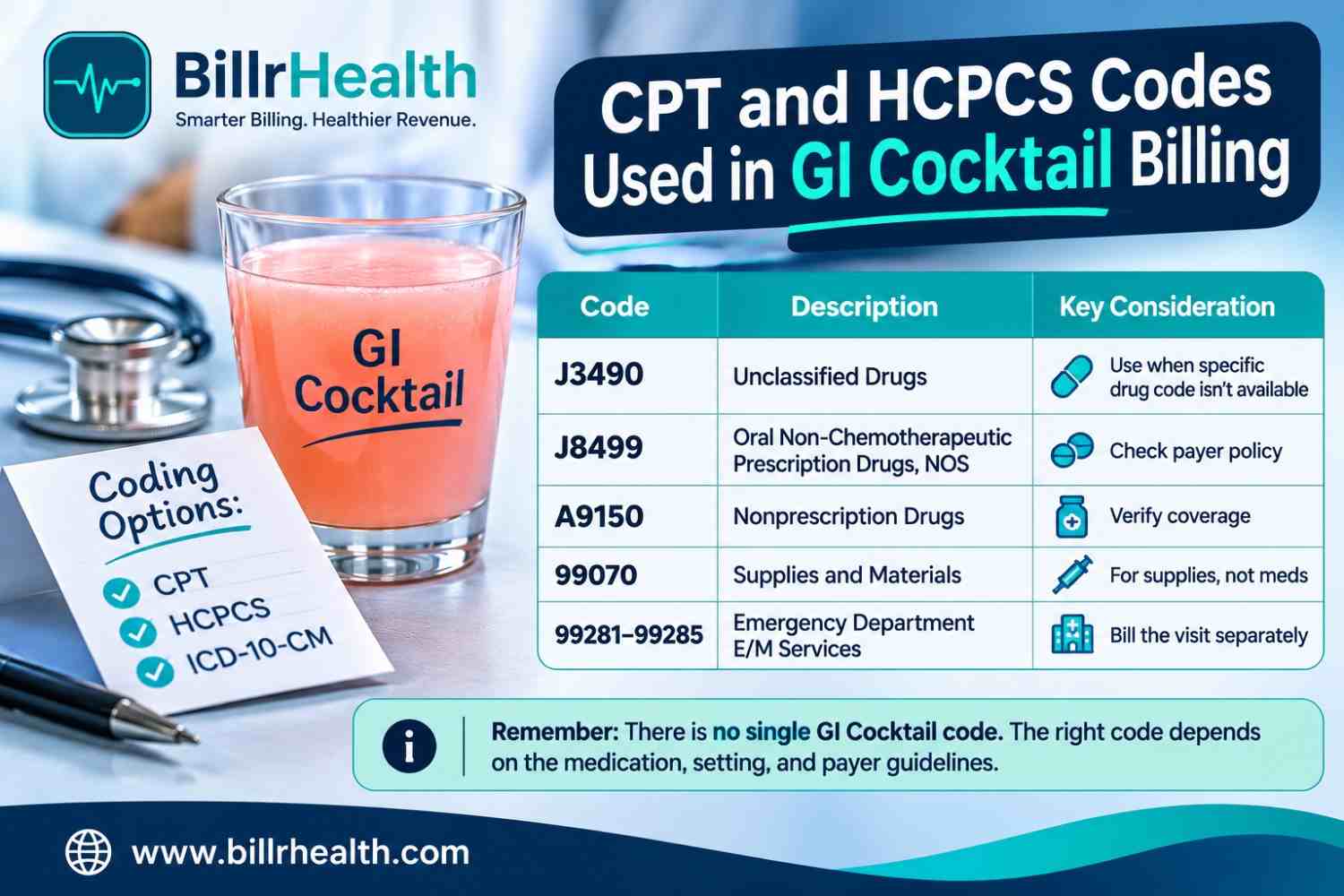
CPT and HCPCS Codes Used in GI Cocktail Billing
These are codes to evaluate, not interchangeable “GI cocktail codes.” Whether one applies depends on the drug, route, setting, code year, and payer policy.
| Code | Description / purpose | Important coding consideration |
|---|---|---|
| J3490 | Unclassified drugs | Drug identification and payer instructions matter |
| J8499 | Oral non-chemotherapeutic prescription drug, NOS | Confirm the specific oral drug qualifies |
| A9150 | Nonprescription drugs | Verify payer acceptance and reporting rules |
| 99070 | Supplies and materials | A medication mixture isn’t automatically a payable supply |
| 99281–99285 | Emergency department E/M services | Level follows documented medical decision making (MDM) |
Here’s why HCPCS codes for GI cocktail billing get messy. Antacids are typically over-the-counter, while viscous lidocaine is a prescription drug. So no single code cleanly describes the whole mix, and oral medication billing needs a payer-by-payer check.
GI Cocktail ICD-10-CM Diagnosis Codes
ICD-10-CM codes describe why the patient needed treatment, not the cocktail itself. Report only what the record supports, and verify current-year descriptors and specificity.
| ICD-10-CM code | Diagnosis |
|---|---|
| K21.9 | GERD without esophagitis |
| K30 | Functional dyspepsia |
| R10.9 | Unspecified abdominal pain |
| R11.0 | Nausea |
| R11.2 | Nausea with vomiting |
These are examples, not automatic diagnoses for every GI cocktail encounter.
How GI Cocktail Billing Changes by Healthcare Setting
Same drink, different claim. Professional and facility claims follow different rules, so the same medication doesn’t get identical treatment everywhere.
Physician Office Billing
Offices submit professional claims, and the cocktail often folds into the E/M unless the payer allows separate reporting. Our internal medicine billing work shows how much payer rules vary here.
Hospital Outpatient and Emergency Department Billing
Facility claims follow facility rules. Emergency department E/M coding depends on documented MDM, and Medicare’s self-administered drug policies can affect payment.
Ambulatory Surgery Center Billing
ASCs bill facility claims, and drug payment is often packaged with the procedure. Review the payer’s ASC policy before reporting anything separately.
Documentation Requirements for Accurate GI Cocktail Coding
Before you report anything, confirm the chart includes:
- Medication names, dosages, and quantities: every ingredient, not just “GI cocktail”
- Route and administration details: oral, time given, and who administered it
- Provider order and medical necessity: why the treatment was needed
- Supporting clinical notes: symptoms, exam findings, and response to treatment
If a reviewer can’t tell what was given and why, expect a denial.
Does Medicare or Private Insurance Cover GI Cocktail Billing?
Not automatically. Separate payment should never be assumed.
Medicare and Self-Administered Drug Considerations
Medicare generally excludes drugs that are usually self-administered. Don’t claim every GI cocktail is excluded, though. Coverage depends on the drug, setting, and circumstances, so check CMS guidance and your MAC’s policy.
Commercial Insurance Coverage and Authorization
Commercial payers and state Medicaid programs set their own rules. Some want specific codes, while others deny anything unlisted.
Understanding Bundled Payments and Reimbursement
NCCI edits and payer bundling can fold the drug into the E/M payment. Strong revenue cycle management means knowing this before the claim goes out, not after.
Common GI Cocktail Coding Errors and Claim Denials
According to Billr Health’s data, about 40% of denials come from fixable coding errors, and 65% are never re-appealed. A GI cocktail insurance claim denial is often the preventable kind. See the top reasons claims get denied and our denial management approach.
| Common mistake | Better approach |
|---|---|
| Using one code for every GI cocktail | Evaluate the actual medication and service |
| Selecting the E/M level because a drug was given | Follow documented E/M criteria |
| Assuming Medicare covers every medication | Review the applicable coverage policies |
| Reporting incomplete drug information | Document drug name, dose, quantity, and route |
| Ignoring payer policies | Verify payer rules before submission |
If a denial still lands, here’s how to appeal a denied claim.
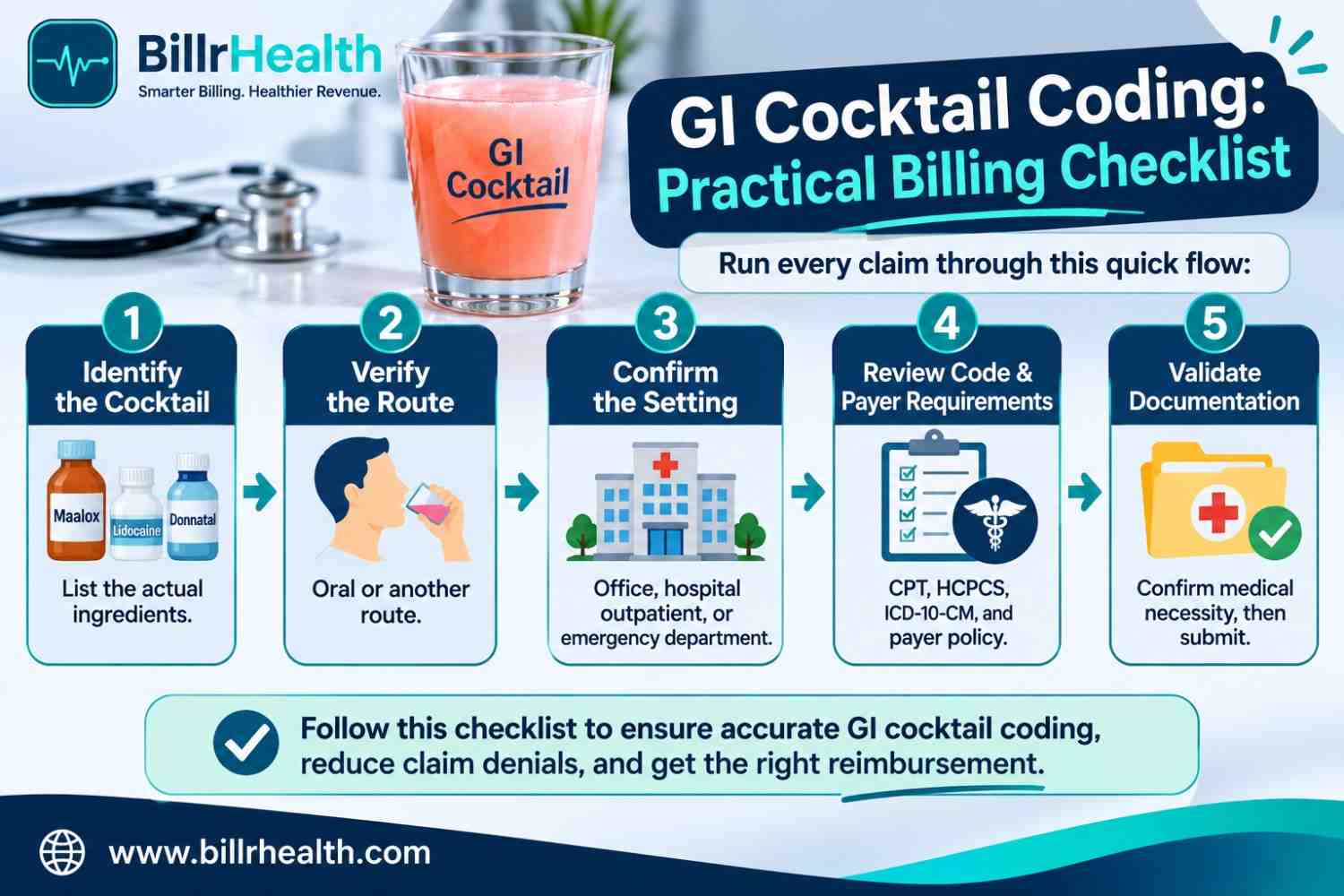
GI Cocktail Coding: Practical Billing Checklist
Run every claim through this quick flow:
- Identify the cocktail: list the actual ingredients.
- Verify the route: oral or another route.
- Confirm the setting: office, hospital outpatient, or emergency department.
- Review code and payer requirements: CPT, HCPCS, ICD-10-CM, and payer policy.
- Validate documentation: confirm medical necessity, then submit.
Pre-submission claim scrubbing catches many of these gaps early.
Hypothetical scenario: A patient arrives at a hospital emergency department with upper abdominal discomfort. The provider documents findings and orders an oral GI cocktail. Your coder should score the E/M from MDM alone, confirm each ingredient, dose, and route, then check the payer’s policy before reporting the drug separately.
Frequently Asked Questions About GI Cocktail Coding
Is there a CPT code specifically for a GI cocktail?
No. CPT has no dedicated code for GI cocktails. Coders evaluate the E/M visit, the specific medications given, and any administration service separately, then follow payer policy for what’s reportable and payable.
Can J3490 be used for GI cocktail billing?
Sometimes. J3490 is an unclassified drug code, so some payers accept it when you identify the drug clearly. Others reject or bundle it, so confirm the payer’s instructions before submitting.
Is J8499 appropriate for oral GI cocktail medication?
Only if the oral medication is a prescription drug and the payer accepts it. J8499 covers non-chemotherapeutic prescription oral drugs, not otherwise specified, so verify the ingredients and payer rules first.
Does Medicare reimburse GI cocktail medications?
Not automatically. Medicare generally excludes drugs usually self-administered, and coverage depends on the drug, setting, and circumstances. Review the applicable CMS and MAC policies instead of assuming a blanket exclusion or approval.
Can a GI cocktail be billed separately from an E/M visit?
Sometimes, but don’t count on it. Many payers bundle the cocktail into the E/M visit. Separate reporting requires detailed documentation, a payer that allows it, and no NCCI or contract bundling conflict.
Final Thoughts
GI cocktail coding comes down to one habit: code what was documented, not what the nickname implies. Match the drug, route, setting, and payer rules, and you’ll avoid most denials before they happen.
If your team is tired of chasing these claims, Billr Health can help. Our billing specialists and AI-assisted tools work together, and our clients see a 98% first-pass claim acceptance rate. Explore our medical coding services, review pricing (3-7% of collections, no setup fees, no long-term contracts), or contact us.

Billr Health was founded by healthcare revenue cycle veterans who spent years inside billing departments, clearinghouses, and payer organizations — and saw exactly where the revenue was being lost. We built the company we wished had existed when we were on the other side of this problem. Our founders spent years working inside billing departments, RCM companies, clearinghouses, and payer organizations. They saw the same problems across every practice they worked with — staff overwhelmed by claim volume, denials not being appealed, AR aging without anyone noticing, coding that was systematically leaving money behind.