
You trained for years, passed your boards, and opened your doors. So why are insurance payments stuck? Often the culprit is provider credentialing for insurance, the verification step payers require before treating you as in-network. Without it, claims stall and revenue lags. Think of it like a passport check: you can be a fantastic traveler, but no stamp means no entry. This guide covers requirements, the application process, timelines, and common delays, so you know what to prepare, submit, and confirm before billing.

What Is Provider Credentialing for Insurance?
Provider credentialing for insurance is the process payers use to verify a provider’s education, training, licenses, board certifications, work history, and malpractice record before admitting them to a network. Approval is your gateway to in-network participation, though requirements differ by payer. You’ll also hear it called insurance paneling or healthcare provider credentialing.
Many payers follow National Committee for Quality Assurance (NCQA) standards, so the checks feel similar everywhere. For the bigger picture, see our guide to the medical credentialing process.
Who Needs Insurance Provider Credentialing?
Most billing clinicians do:
- Physicians and specialists
- Nurse practitioners (NPs) and physician assistants (PAs)
- Dentists and behavioral health providers
- Other eligible professionals, like therapists
Why Is Provider Credentialing Important for Insurance Participation?
Credentialing isn’t paperwork for paperwork’s sake. It pays off three ways.
Access to Insurance Networks
Network participation lets you treat patients covered by plans like Aetna and UnitedHealthcare.
Insurance Reimbursement and Revenue
Accurate credentialing and enrollment establish eligibility for payer reimbursement, so fewer claims bounce. See how revenue cycle management ties it together.
Patient Trust and Practice Growth
In-network care costs patients less, which makes choosing you an easy yes.
What Are the Requirements for Provider Credentialing for Insurance?
Gather everything before you apply. Missing items cause most early delays.
Essential Provider Credentialing Documents
- Active state medical license
- National Provider Identifier (NPI)
- CAQH ProView profile, when required
- Current CV
- Education and residency details
- Board certification
- DEA registration, when applicable
- Professional liability insurance certificate
- Malpractice claims history
- Hospital affiliations, when applicable
- Work history and references
- Tax Identification Number (TIN) and practice details
Picture a new three-clinician clinic. Two providers have complete CAQH profiles, but one has an expired malpractice certificate. That single gap can stall the whole group submission. Need help? Our CAQH profile setup guide walks you through it.
Individual vs. Group Provider Requirements
Individuals use a Type 1 NPI; organizations use Type 2. Payers want personal credentials for each clinician, plus group details such as TIN, address, and ownership.
How Does the Insurance Provider Credentialing Process Work?
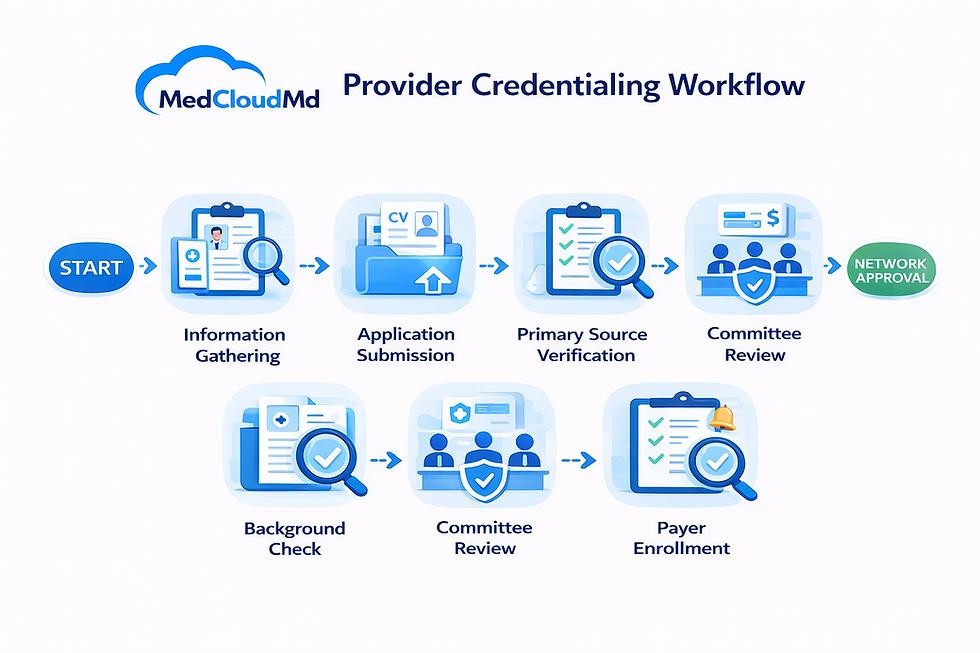
Here’s the road map from application to your first in-network claim.
Step 1: Identify the Right Insurance Payers
Research which insurers your local patients use, including Medicare, Medicaid, and commercial plans such as Blue Cross Blue Shield. Confirm each payer is accepting new providers.
Step 2: Get Your NPI and Complete Your CAQH Profile
Register for free in the National Plan and Provider Enumeration System (NPPES) to get your NPI. Then build your CAQH ProView profile, a shared data hub from the Council for Affordable Quality Healthcare (CAQH). Authorize payers to view it and re-attest every 120 days.
Step 3: Prepare and Submit Applications
Complete each payer’s application, upload supporting documents, and submit through its portal, such as Availity where supported. Save copies and confirmation numbers.
Step 4: Complete Primary Source Verification (PSV)
Payers, or a Credentials Verification Organization (CVO), confirm your credentials directly with licensing boards and schools. They also screen the Office of Inspector General (OIG) exclusion list.
Step 5: Complete Insurance Contracting
Approved providers review and sign the participation agreement, which sets reimbursement terms and responsibilities. Read the fee schedule before signing.
Step 6: Receive Approval and Confirm Network Status
Check your effective date, directory listing, and payer-system status before billing as in-network. For Medicare, enrollment runs through the Provider Enrollment, Chain, and Ownership System (PECOS), reviewed by the Centers for Medicare & Medicaid Services (CMS).
Provider Credentialing vs. Insurance Enrollment vs. Contracting
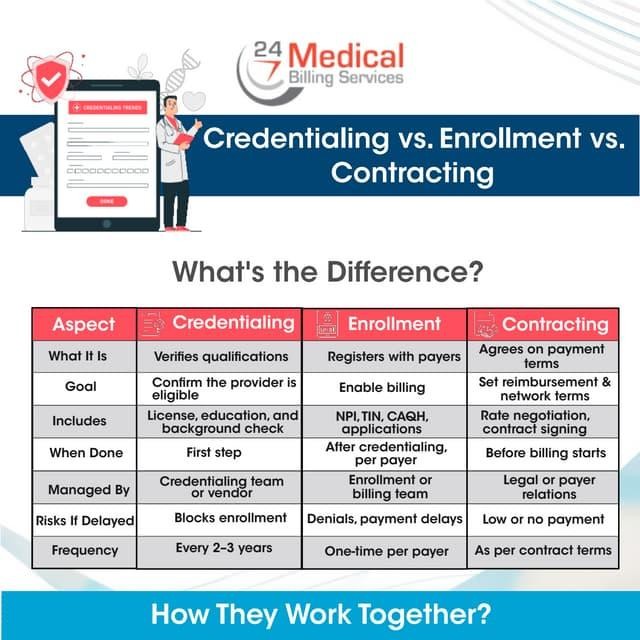
| Process | Main Purpose | Expected Outcome |
|---|---|---|
| Provider credentialing | Verifies qualifications and professional background | Credentials reviewed and approved |
| Insurance enrollment | Registers the provider with a payer or government program | Provider registered for participation |
| Insurance contracting | Establishes the legal agreement between payer and provider | Participation and reimbursement terms set |
Confused? Picture a job hire: credentialing is the background check, enrollment is getting on payroll, contracting is signing the offer letter. These steps are related, but they’re not interchangeable. Their order and requirements vary by payer, so ask each one how it sequences them.
How Long Does Provider Credentialing for Insurance Take?
There’s no single timeline. Timing depends on the payer, your specialty, how complete your application is, verification needs, and contracting. Always separate credentialing approval from contract activation, and rely on each payer’s published estimates. Our credentialing timeline guide goes deeper, and our Medicaid credentialing guide covers state differences.
| Credentialing Stage | What Affects the Timeline? |
|---|---|
| NPI registration | Application accuracy and processing |
| CAQH profile preparation | Document collection and verification |
| Medicare enrollment | Application type and CMS review |
| Medicaid enrollment | State-specific requirements |
| Commercial payer credentialing | Payer review and verification |
| Contracting and activation | Agreement review and effective-date confirmation |
Common Insurance Credentialing Challenges and How to Avoid Them
Most delays are avoidable. Here’s what trips practices up:
Missing or Incorrect Documents
Double-check every document before you submit.
Incomplete CAQH Information
Outdated data delays verification, so re-attest on time.
Delayed Payer Follow-Ups
Keep a tracking sheet and check in with payer reps regularly.
Expired Licenses or Certifications
Calendar every expiration date; a lapsed license can pause everything.
Insurance Panel Closures
Confirm the panel is open before investing weeks in an application.
Key Credentialing Dates to Track
| Item | Typical Figure |
|---|---|
| NPI format | 10-digit number, issued once |
| CAQH re-attestation | Every 120 days |
| NCQA recredentialing cycle | At least every 36 months |
| Medicare revalidation | Generally every 5 years |
What Happens After Insurance Credentialing Approval?
Approval is a starting line, not a finish line. Our health plan credentialing guide covers more. Next:
- Confirm the payer’s effective date
- Finalize the participation agreement
- Verify your details in payer systems
- Check your network directory listing
- Set up billing info and payer IDs
- Confirm claim readiness before billing
Even then, approval doesn’t guarantee every claim gets paid. Run eligibility verification, use claim scrubbing, and build solid medical billing and denial management workflows.
Frequently Asked Questions About Provider Credentialing for Insurance
1. What is provider credentialing for insurance?
It’s the verification process where insurers confirm a provider’s licenses, education, training, certifications, malpractice record, and professional history before allowing participation in their network, helping establish eligibility for in-network reimbursement.
2. Do all healthcare providers need insurance credentialing?
Not always. Requirements depend on provider type, payer rules, and participation arrangements. Providers who want in-network status with most insurers typically need it, while cash-only practices generally don’t need payer credentialing.
3. Is CAQH required for every insurance company?
No. Many payers use CAQH ProView to collect provider data, but requirements vary. Some insurers use their own applications or portals, so always confirm each payer’s rules before you apply.
4. Can a provider see patients before credentialing is complete?
Seeing patients and billing in-network are separate issues. Payer agreements and policies decide what’s permitted, so verify your status first; otherwise claims may deny or be paid at out-of-network terms.
5. What happens if an insurance credentialing application is denied?
Review the denial reason, correct any deficiencies or missing documents, and follow the payer’s reconsideration or appeal process. Keep records of every submission, and ask your payer representative about resubmission timelines.
6. How often do providers need recredentialing?
It depends on payer policies and applicable standards. NCQA-aligned plans generally recredentialed at least every 36 months, and Medicare requires periodic revalidation, so track every renewal date on a calendar.
Final Thoughts: Simplify Insurance Credentialing With Professional Support
Accurate provider data, timely applications, and steady follow-ups are what get you paid. Get credentialing right, and everything downstream gets easier. If tracking payers feels like a second job, Billr Health’s provider credentialing and medical billing support can help. Contact our team to get started.

Billr Health was founded by healthcare revenue cycle veterans who spent years inside billing departments, clearinghouses, and payer organizations — and saw exactly where the revenue was being lost. We built the company we wished had existed when we were on the other side of this problem. Our founders spent years working inside billing departments, RCM companies, clearinghouses, and payer organizations. They saw the same problems across every practice they worked with — staff overwhelmed by claim volume, denials not being appealed, AR aging without anyone noticing, coding that was systematically leaving money behind.